Stay ahead of the curve
Get exclusive insights delivered directly to your inbox. Join thousands of tech leaders.
TL;DR
- What are the steps in a technology scouting process? Frame the decision, scout wide, cluster the options into competing routes, measure each route, give each route a verdict, and re-check every quarter.
- Why do scouting projects stall? They stop at the long list. A hundred options and no defensible way to rank them leaves the decision to familiarity and gut feel.
- How do you narrow 100 options to a handful? Group them into routes that compete for the same job, then rank the routes on two numbers, maturity (TRL) and improvement rate.
- Which verdicts should a scouting project end with? Fund, Monitor, Phase out or Ignore. Each follows from where a route sits on maturity and improvement rate.
- How often should you re-check? Every quarter for the routes you fund or monitor. New routes appear, pilots succeed or fail, and rate estimates update with new data.
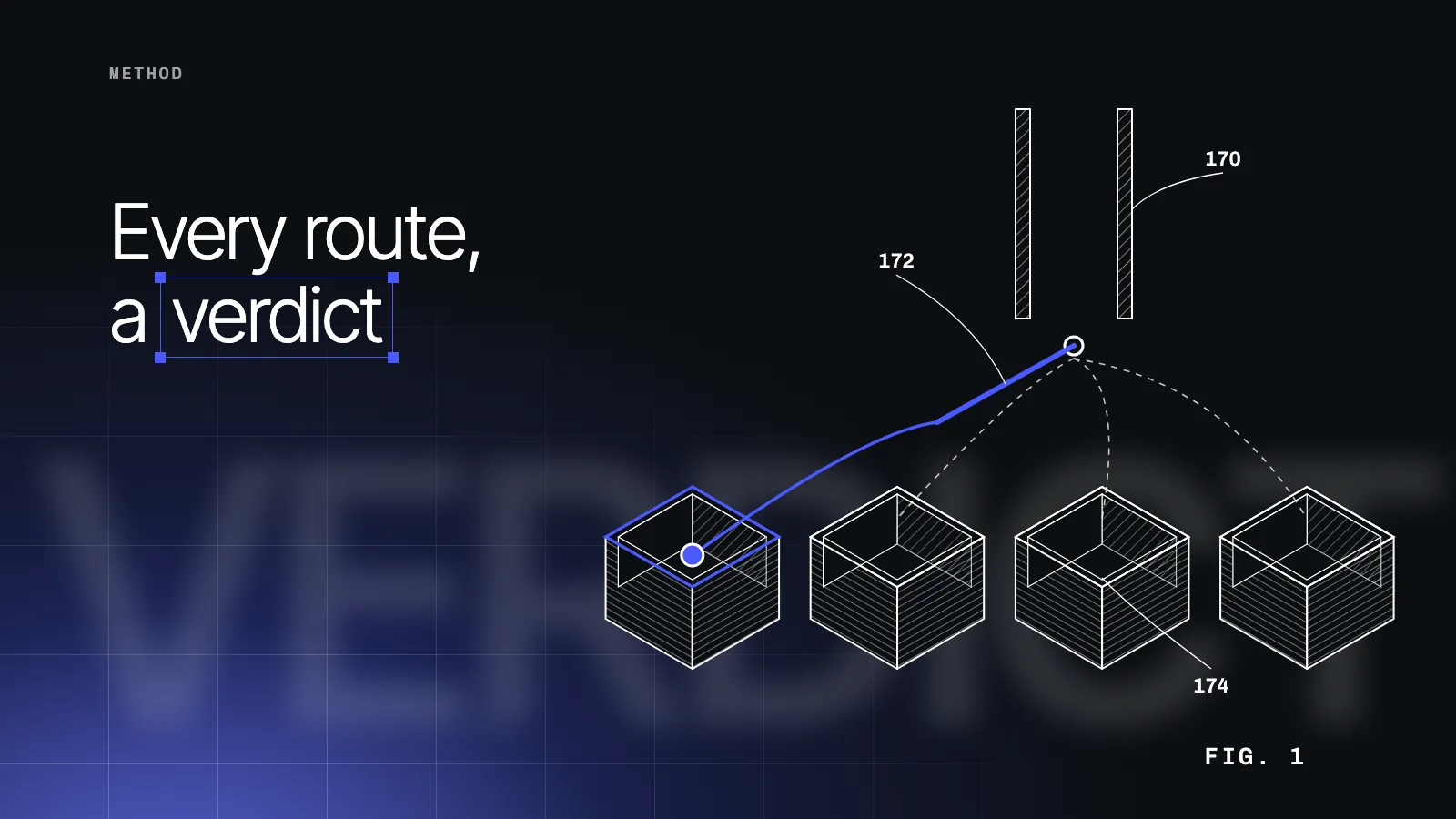
The technology scouting process runs in six steps: frame the decision, scout wide, cluster the long list into competing routes, measure each route's maturity and improvement rate, give each route a verdict (Fund, Monitor, Phase out or Ignore), and re-check every quarter. The measuring step is where most processes go thin, so this one spends its effort there.
Christophe Perthuisot, former SVP of R&D at Moët Hennessy, describes the job on our podcast as getting from a hundred candidate technologies to the four or five worth examining. Here is a process that does it, step by step, with a worked example.
Why most technology scouting stalls at the long list
Finding options has never been easier. Patent databases, publication search and startup platforms will produce a hundred candidates for almost any technical problem. The bottleneck is what comes next.
Innovation funnels are steep: a classic study by Stevens and Burley estimated that it takes about 3,000 raw ideas to produce one commercial success. Scouting adds to the top of that funnel, and without a way to narrow it, the extra options become extra work. INSEAD's Felipe Monteiro found that idea-hunting mandates "can leave the company inundated with possibilities". In interviews we ran with R&D leaders in 2025, teams described spending months narrowing 50 options down to two or three.
The fix is a process that ends in verdicts, built on measurements that everyone can inspect.
From 100 options to the 4 worth funding
Step 1: Frame the decision
Write the decision in one sentence before anyone starts searching:
By [date], we will fund [number] routes to [job], judged on [performance per unit of cost], within [budget].
Three choices shape everything that follows:
- The job. Describe the function, not a technology. "Produce ethylene with lower emissions" invites more routes than "improve our crackers".
- The performance measure. Pick the measure the decision depends on, per unit of cost. Step 4 measures every route against it.
- The horizon. NASA's 2023 review of scouting practice distinguishes near-term gap filling (1–5 years), incubating answers to known needs (5–10 years) and horizon scanning (10+ years). A five-year decision and a fifteen-year decision deserve different shortlists.
Output: a decision statement, signed off by whoever owns the budget.
Step 2: Scout wide
Search everywhere the answer could come from: patents, scientific papers, startups, suppliers, universities, government labs and industries that solve a similar problem. The US Department of Homeland Security's scouting programme lists academia, laboratories, government, industry and international activity among its sources.
Two habits keep the search wide:
- Look one industry over. Established firms fall into what Ahuja and Lampert call the familiarity trap, "favoring the familiar" over the new. Many of the best routes come from a neighbouring field.
- Hold off on filtering. At this stage a long list of 100 options or more is a good sign.
Output: the long list.
Step 3: Cluster the long list into routes
A route is a distinct technical approach to the job. The options on your long list, such as startups, suppliers and research groups, sit inside routes. Choose the route first and the partner second, because the route sets the ceiling on what any partner can deliver.
In our ethylene example, more than a dozen technical approaches compete to make the same molecule: steam cracking and its electrified version, methanol-to-olefins, ethanol dehydration, oxidative coupling of methane, and several routes that start from CO₂, fourteen routes in all.
Output: a route map, with every option assigned to a route.
Step 4: Measure each route: maturity and improvement rate
Give every route two numbers.
- Maturity. Use the technology readiness level (TRL) scale, from TRL 1 (basic principles observed) to TRL 9 (a proven system in operation). Maturity tells you where a route is today.
- Improvement rate. Measure the annual rate at which the route's performance per unit of cost is improving. It tells you where the route is going. Rates can be measured from performance data or, for younger routes, estimated from patent citation data; our explainer on why technology improvement is predictable shows both methods.
Rates differ more than most teams expect. In the ethylene analysis:
| Route | Annual improvement rate |
|---|---|
| Electrochemical CO₂ to CO | 43.6% |
| Photocatalytic CO₂ reduction | 37.8% |
| Oxidative coupling of methane | 26.3% |
| Thermocatalytic CO₂ conversion | 23.6% |
| Methanol-to-olefins | 20.9% |
| Electrified steam cracking | 19.8% |
| Ethanol-to-ethylene | 15.4% |
| Conventional steam cracking | 13.0% |
Output: two numbers per route, with the evidence behind each.
Step 5: Give each route a verdict
Plot maturity against improvement rate, and each route falls into one of four verdicts.
| Verdict | Maturity | Improvement rate | What to do |
|---|---|---|---|
| Fund | High | Fast | Put money and people behind it now. |
| Monitor | Low | Fast | Track closely and build capability; it will not stay immature. |
| Phase out | High | Slow | Plan the transition and limit new investment. |
| Ignore | Low | Slow | Drop it from the active list and review it yearly. |
"Fast" is relative to the alternatives, so compare each route's rate with the incumbent's and with the other routes in the same decision. A route improving at 20% a year is fast against an incumbent at 13%, and slow against a challenger at 40%.
Output: a verdict for every route, with a sentence explaining it. Most shortlists end with a handful of routes to fund and a few more to monitor.
Step 6: Re-check every quarter
A verdict is a snapshot. Every quarter, re-check the routes you fund or monitor:
- New routes. Has a new approach appeared that belongs on the map?
- Maturity milestones. Has a pilot succeeded, failed or slipped?
- Rates. Have new patents or performance data moved an estimate?
- Triggers. Agree in advance what would reopen a verdict, such as a Monitor route reaching TRL 6.
Keep the output to a page. Deutsche Telekom's scouts summarised each technology on a one-page profile, feeding a radar that gave managers an overview of about 60 technologies.
Output: an updated one-page view of every route and its verdict.
Worked example: fourteen routes to low-carbon ethylene
At the Chemical Innovation Exchange (CIEX) in Indianapolis in September 2026, GetFocus put fourteen routes to low-carbon ethylene on a single chart of maturity against improvement rate.
- Conventional steam cracking sits where you would expect: fully mature, improving at 13.0% a year, and still responsible for almost all production. Its verdict is to plan the transition.
- Electrochemical routes sit in the opposite corner: early and unproven at scale, but improving at up to 43.6% a year. The verdict is to monitor them closely, because they will not stay immature.
- The middle of the field, including methanol-to-olefins and electrified cracking, improves at roughly one and a half times the incumbent's pace.
The analysis also raised a question no technology list would have asked: does the organisation have the right people? Electrochemistry needs different specialists and different test rigs from thermal catalysis, and a hiring plan takes years to change the shape of a research team. Read the full ethylene analysis.
A one-page scouting brief you can copy
Use one page per decision, and keep it current every quarter:
- Decision: what you will fund, by when, within which budget.
- Performance measure: the per-cost measure every route is judged on.
- Horizon: 1–5, 5–10 or 10+ years.
- Routes: each route with its TRL, improvement rate, verdict and the evidence behind them.
- Owner and next check date: who re-checks, and when.
For a fuller method of comparing the shortlisted routes, see how to compare competing technologies objectively.
FAQ
What is the technology scouting process?
A technology scouting process is the sequence of steps that turns a business need into a funded shortlist of technologies. A complete process frames the decision, searches widely, groups options into competing routes, measures each route's maturity and improvement rate, gives each a verdict, and re-checks the verdicts regularly.
How do you evaluate technologies in a scouting process?
Judge every route on the same two measures: maturity, on the technology readiness level (TRL) scale, and improvement rate, the annual rate at which its performance per unit of cost is improving. Cost, fit and risk then refine the shortlist. Measuring all routes the same way makes the evaluation comparable and easy to defend.
What is a technology selection process?
Technology selection is the final part of the scouting process: choosing which routes, and then which partners, to fund. Selection is easier to defend when it follows explicit verdicts (Fund, Monitor, Phase out or Ignore) based on measured maturity and improvement rate.
How many options should a scouting long list have?
There is no fixed number, but a long list of around 100 options is common for a broad technical question. The number of routes matters more than the number of options; the ethylene analysis above compared fourteen.
How long does a technology scouting process take?
It depends on scope, and there is no reliable industry benchmark. A NASA review in 2023 found that many organisations do not track scouting metrics at all. GetFocus delivers a Decision Brief mapping the competing routes for a single decision in 48 hours.
What is the difference between technology scouting and technology evaluation?
Scouting finds and organises the options. Evaluation measures them against each other. In the six steps above, steps 1 to 3 are scouting and steps 4 to 6 are evaluation and selection.
Send us your long list
Bring us one technology decision and the options you are weighing. Within 48 hours, a free Decision Brief maps the competing routes by improvement rate, ready for your verdicts.
Sources
- GetFocus podcast: Christophe Perthuisot on technology bets. getfocus.eu/podcast
- Stevens, G.A. and Burley, J. (1997). 3,000 raw ideas = 1 commercial success! Research-Technology Management, 40(3), 16–27. doi.org/10.1080/08956308.1997.11671126
- Monteiro, L.F. (2015). Generate more value from your external knowledge sourcing. INSEAD Knowledge. knowledge.insead.edu
- NASA Office of Technology, Policy and Strategy (2023). Technology Scouting Phase 1 Report. ntrs.nasa.gov
- US Department of Homeland Security, Science and Technology Directorate. Technology Scouting. dhs.gov
- Ahuja, G. and Lampert, C.M. (2001). Entrepreneurship in the large corporation. Strategic Management Journal, 22(6–7), 521–543. doi.org/10.1002/smj.176
- NASA. NPR 7123.1D, Appendix E: Technology Readiness Levels. nodis3.gsfc.nasa.gov
- Rohrbeck, R. (2010). Harnessing a network of experts for competitive advantage: technology scouting in the ICT industry. R&D Management, 40(2), 169–180. doi.org/10.1111/j.1467-9310.2010.00601.x
- GetFocus (2026). Fourteen routes to ethylene: why maturity won't tell you which wins. getfocus.eu/blog