Stay ahead of the curve
Get exclusive insights delivered directly to your inbox. Join thousands of tech leaders.
TL;DR
- Start from the job your product does and list every route that could do it, including routes from other industries and routes your company dismissed years ago.
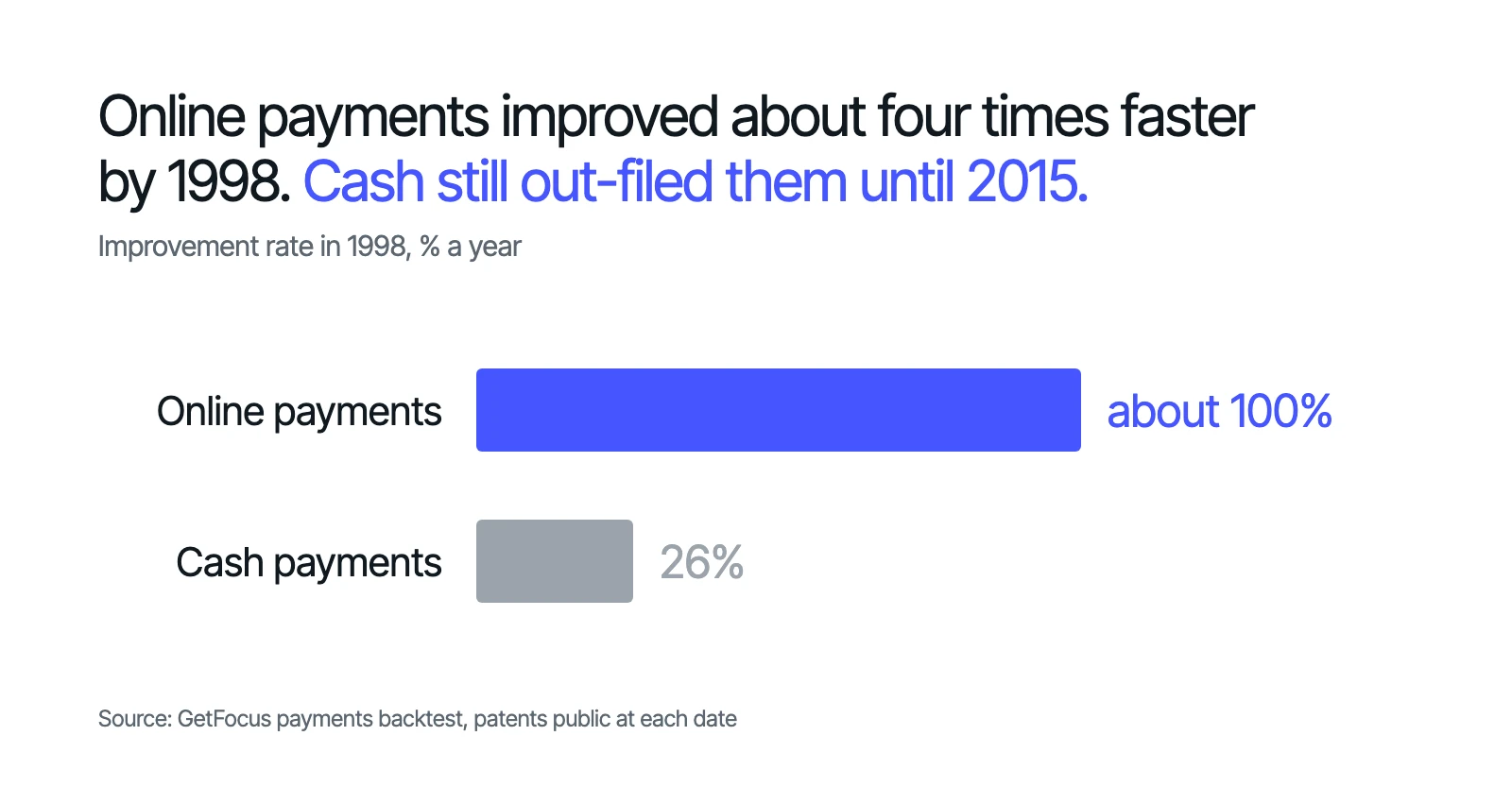
- In GetFocus's payments backtest, online payments read about 100% a year by 1998 against 26% for cash-payment infrastructure, and the cash-payment industry out-filed them every year until 2015.
- Compare routes on one unit, percent better per year. MIT researchers estimated rates from 2% to 216% a year across 1,757 technology domains.
- Re-check monthly in most domains and search again for new routes every quarter. The improvement rate is a directional signal.
To watch for technology obsolescence, start from the job your product does, list every route that could do that job, including routes from other industries, and track how fast each one improves on a schedule: monthly suits most domains. The route that replaces a product can start well outside its own sector. In GetFocus's payments backtest, online payment systems were improving at about 100% a year by 1998 against 26% for cash-payment infrastructure, and the cash-payment industry still out-filed them every year until 2015.
We build GetFocus, which measures how fast technologies improve from the way patents cite each other. The backtests quoted here use only the patents that were public at each date, and every outside figure links to its source. Last updated: 20 November 2026.
- Watch the job. A list built from the technologies you already know leaves out the routes you have never worked on.
- Look across industries. In imaging, semiconductor sensors replaced film chemistry. In payments, online payments came for cash.
- Compare on one unit. Percent better per year puts every route on the same scale. MIT researchers estimated rates from 2% to 216% a year across 1,757 technology domains (MIT News, August 2021).
- Re-check on a schedule. Search again for new routes every quarter. The improvement rate is a directional signal.
How do we keep an eye on technologies that could make our current products obsolete?
Watch the job your product does and every route competing for it. Our guide to tools that monitor a technology area automatically covers the basics: place each route by maturity and improvement rate, give it a verdict, and re-run on a schedule. This article covers the part that guide keeps short, which is deciding what belongs on the list. Three additions bring in the routes a sector's own view leaves out:
- Write the job in one sentence with no technology in it. "Let a buyer pay a seller" is a job, and dispensing banknotes is one route to it.
- Search by function, in plain words. A route described in another field's vocabulary then still turns up. GetFocus retrieves patents by meaning for this reason (the method page shows how).
- Put dismissed routes back on the list. A route your company looked at years ago and rejected gets a fresh reading.
Why can technology obsolescence start in another industry?
In-house expertise follows the problems a company already has. Jard van Ingen, co-founder and CEO of GetFocus, said it this way in a recorded conversation with co-founder Thijs van de Poll in 2026: "All companies have lots and lots and lots of experts, but what you tend to have experts on is the problems that you have already." He was describing technologies that emerge adjacent to an industry, where the industry has little expertise of its own.
Payments shows the pattern in the patent record. Online payment systems entered the record in 1995, and three years later they read about 100% a year against 26% for cash-payment infrastructure: ATMs, point-of-sale terminals and cash handling. By 2004 the online reading was 331%. The names on that timeline are Confinity (PayPal's ancestor), Alipay, M-Pesa, Stripe and Apple Pay, and none of them was a maker of cash machines. The cash-payment industry out-filed online payments every year until 2015. Diebold Nixdorf, a leading ATM maker, filed for Chapter 11 on 1 June 2023 (the full case).
Imaging has the same shape. Kodak's product was silver-halide film, a chemical technology, and the routes that replaced it were semiconductor image sensors. In the Kodak backtest the signal is dated 1980: CCD imagers read 89.8% a year against 17.3% for film, and film read between 17% and 26% a year in every reading on the page. Film sales fell steeply in 2000, two decades after that first reading.
Institutional memory is the second blind spot. Van Ingen describes finding important emerging technologies that a company had never considered, and says it typically happens when they emerge outside the company's industry, or because "they were looked at many years ago and they were dismissed for some reason", which "becomes part of the institutional memory and they just don't look at it again." When your own experts disagree about one of these routes, our article on expert bias in R&D decisions covers how to put a measured rate next to their judgement.
What does a job-first watch list look like on a live question?
Take the job "make low-carbon ethylene". GetFocus's public ethylene radar (updated September 2026) lists fourteen routes to it. Steam cracking, the benchmark, improves at 13.0% a year, the slowest rate in the set. The fastest is electrochemical CO₂-to-ethylene at 44.1% a year, more than three times the benchmark and the only route that sped up every year from 2017 to 2023. A watch list limited to cracking variants would leave it out. Van Ingen's comment about the chemical industry applies here: "You can have all the chemical experts in the world, but in the future you're going to need electrochemical experts if you're going to compete in that space."
The same radar shows why a rate is read together with other evidence. Where patents quote energy use, CO₂ electrolysis still needs 38–74 MWh per tonne of ethylene against 1.5–5.7 for electrified cracking. The verdict line under the radar's title holds both facts: CO₂ electrolysis will not match cracking on energy per tonne, and it is improving fast enough that power prices now decide. Its verdict for the route is fund, starting with pilots.
How can we compare the rate of improvement of competing technologies measured on different performance metrics?
Convert each one to the same unit: percent better per year. A route from another industry arrives with its own yardsticks, and its annual rate of improvement can still be set next to yours. The rates differ widely. Across 1,757 technology domains, MIT researchers estimated rates from 2% to 216% a year, with more than 80% of technologies improving at less than 25% a year (MIT News, August 2021).
For an emerging route a clean performance history rarely exists, so the rate has to be estimated. An MIT study of 28 technology domains found that patent citation measures correlate strongly with a domain's improvement rate, while the amount of patenting in a domain showed no statistically significant relationship with it (Benson & Magee, 2015). GetFocus estimates the rate from two citation measures, cycle time and knowledge flow, so every route is read in the same unit. Our guide to comparing competing technologies objectively walks through the method.
We have a small team and too many technologies to watch. How do we keep track of what really matters?
Count jobs before technologies, and let the verdicts decide what gets read. The ethylene radar covers one job with fourteen routes. Seven of them clear the set's median improvement rate of 20% a year, and only one is both fast and past lab scale with a growing filing base.
The verdicts shorten the reading list. Routes marked phase out or ignore need a glance at each re-check, and the team's time goes to the routes marked fund or monitor and to any route whose verdict changed since the last run. Christophe Perthuisot, a former SVP of R&D in consumer goods, puts it this way in his story: "It allows you to boil things down from perhaps 100 solutions to the three, four, or five you really need to examine."
How often should the watch list be re-checked?
Monthly suits most domains, weekly fits fast-moving areas and quarterly fits slower ones (GetFocus monitoring guide). GetFocus Monitoring re-checks a domain on the cadence you choose. Each run adds the newly published patents, recomputes each technology's improvement rate and maturity, and re-answers the standing questions you define, such as who entered a route. Each quarter the domain is scouted again for newly emerging routes.
Each reading gives a direction. The GetFocus guide calls the improvement rate a directional signal, and no guarantee of commercial success, so a verdict change opens a review by the people who own the decision.
Where does this approach apply, and where does it fall short?
It fits a team whose product competes with other technologies for the same job, in fields where companies patent. It is less reliable where secrecy, tacit know-how or weak patenting hide the progress, and it does not cover a threat from a new business model built on the same technology. A rate gives the direction and leaves the date open, and our article on when to move away from a core technology covers the timing.
Pick one product and write its job in one sentence. Send us that sentence and get a free 48-hour Decision Brief: a first-pass radar of the routes competing for the job, with their improvement rates.
FAQ
What is technology obsolescence?
A product becomes technologically obsolete when another technology does the same job better or cheaper. The replacing technology can come from another industry: semiconductor image sensors replaced silver-halide film, and Kodak filed for Chapter 11 on 19 January 2012.
How early can a threat from another industry be seen?
In GetFocus's backtests, years ahead. The Kodak signal is dated 1980, two decades before film sales fell steeply in 2000. Online payments read about 100% a year against 26% for cash-payment infrastructure in 1998, and online payment filings did not pass cash-infrastructure filings until 2015. Each reading uses only the patents public at that date.
How often should we re-check the technologies that threaten our products?
Monthly suits most domains, weekly fits fast-moving areas and quarterly fits slower ones. Search again for newly emerging routes every quarter, because a route that was missing from the first list will never show up in a re-check of that list.
Can patents show a threat that comes from outside our industry?
Yes, when the route is patented. GetFocus retrieves patent families by meaning across the global corpus, so a route described in another field's vocabulary is still found, and its improvement rate is estimated in the same unit as yours. The reading is less reliable where secrecy or weak patenting hide the progress.