Stay ahead of the curve
Get exclusive insights delivered directly to your inbox. Join thousands of tech leaders.
TL;DR
- Funding rounds, press coverage and patent filing volume are attention signals: they record where money and people went.
- Progress is the improvement rate, compared between technologies doing the same job. Automakers had spent more than $9 billion on hydrogen fuel cells by 2014 (UC Davis), while fuel cells read 21% a year against 54% for NMC batteries in 2001 (GetFocus powertrain backtest).
- In the live ethylene radar (September 2026), filings on electrified cracking rose ten-fold while its rate fell from 26.5% to 19.8%. CO₂ electrolysis rose on both, to 44.1% a year.
- The rate is directional. It gives no launch date or market size, and the company behind a technology needs its own check.
Technology hype and real progress are recorded in different data. Funding rounds, press coverage and patent filing volume measure attention: they show where money and people went. Progress is the improvement rate (TIR), the amount a technology's performance improves per year, read from how its patents build on each other and compared with the routes competing for the same job. By August 2014 automakers had spent more than $9 billion on hydrogen fuel-cell development (UC Davis). In GetFocus's powertrain backtest, fuel cells read 21% a year in 2001 against 54% for NMC lithium batteries, and NMC stays ahead in every later reading.
We build GetFocus, which measures how fast technologies improve from the way patents cite each other. The GetFocus figures below come from our public backtests and radars, and every outside figure links to its source.
- Funding, press and patent filing volume record where money and people went. They are attention signals.
- The improvement rate records how much better a technology gets per year. It only means something next to the rates of the technologies doing the same job.
- Attention and progress can point in opposite directions for decades. In the powertrain backtest, hydrogen fuel cells still out-file NMC batteries, 2,841 new patent families a year against 504, while NMC improves about twice as fast.
- The rate is directional and describes the technology. The market and the company behind it need their own checks.
How do you tell technology hype from real progress?
Sort the evidence into two piles. The first pile is attention: funding rounds, government programmes, press coverage and the number of patents filed. The second pile is progress: evidence that the technology gets better from one generation to the next, and faster than the alternatives.
The two piles separate in the data. A study co-authored by MIT's Christopher Magee estimated yearly improvement rates for 1,757 technology domains, which together hold 97% of US patents, and found rates from 2% to 216% a year (MIT News, 2021). In general, the rates were not a strong function of the size of the patent set (Singh, Triulzi and Magee, 2020). A busy field can be a slow one.
The rate works like an interest rate, so a gap widens every year. As an illustration only: if the 2001 readings of 54% and 21% a year each held for ten years, the first technology would end about 75 times better than it started and the second about 7 times better.
In the hydrogen case, the $9 billion is attention, and so are the filings: in the backtest's latest reading hydrogen fuel cells still out-file NMC batteries, at 2,841 new patent families a year against 504. The rate was the progress signal, and it favoured NMC from the first data point in 2001.
What does Gartner's Hype Cycle tell you, and what does it leave open?
Gartner's Hype Cycle, introduced in 1995, places a technology in one of five phases: a technology trigger, a peak of inflated expectations, a trough of disillusionment, a slope of enlightenment and a plateau of productivity (Wikipedia's summary). In our reading, the phases describe the mood around a technology.
GetFocus co-founder and CEO Jard van Ingen put the limit this way in a 2026 conversation with his co-founder: "There's hype, okay. What does that mean? That it's hyped."
A funding decision needs two more facts: whether the technology is getting better, and how fast compared with the routes it competes with. In our reading, a phase on a curve of expectations answers neither. Filings can peak around the slower technology: in GetFocus's display backtest, 3D television drew six times the patent families of 4K and HDR at the 2012 peak, while 4K and HDR improved about twice as fast.
Two technologies are competing for the same job. How do we tell which one will win before the market decides?
Measure both improvement rates the same way and compare them. GetFocus's method page summarises the MIT research behind the rate: where two technologies did the same job, the quicker improver historically took over.
A live example is low-carbon ethylene. The GetFocus ethylene radar (updated September 2026) compares fourteen routes. Electrified steam cracking is where Aramco, Sinopec, BASF and Linde are filing, and its new patent families went from 9 a year in 2017 to 90 in 2024. Its improvement rate fell from 26.5% to 19.8% a year between 2017 and 2023. The radar reads that pattern as a route moving from invention into engineering. Its phase-out verdict rates the technology route, electrified cracking, and the radar gives no verdict on any company.
CO₂ electrolysis rose on both measures. Filings grew from 65 to 317 a year, and the rate more than doubled, from 19.1% to 44.1%, which is more than three times the steam-cracking benchmark of 13.0%. The verdict is fund.
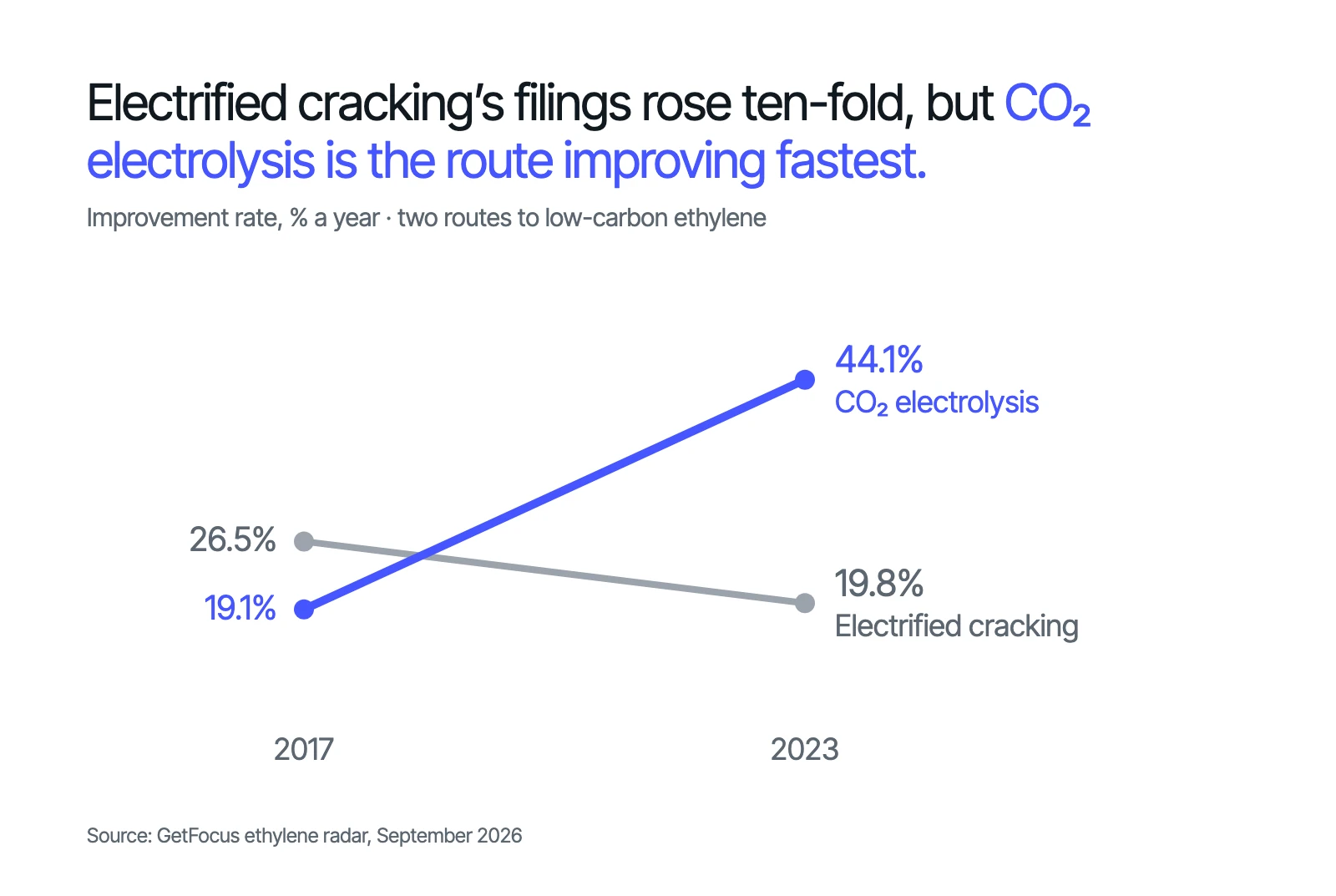
Read by where the incumbents file, electrified cracking looks like the answer. Read by rate, CO₂ electrolysis is the route that is moving. The radar also says what the faster route still has to prove. Where patents quote energy, CO₂ electrolysis needs 38 to 74 MWh per tonne of ethylene against 1.5 to 5.7 for electrified cracking, and thermodynamics sets a floor of 13 MWh per tonne that the rate cannot compound through. The radar's conclusion is that CO₂ electrolysis will not match cracking on energy per tonne and is improving fast enough that power prices now decide.
We're considering investing in a startup. How do we check whether its technology is really ahead of competing approaches?
Start with what the improvement rate cannot tell you. Jard van Ingen names two limits in the same conversation: a fast-improving technology may have no market for the application you have in mind, and the best technology with a weak team or weak marketing can still go wrong. His example is sodium-ion batteries. The GetFocus battery radar reads sodium-ion at about 125% a year, verdict fund, and he points to an American sodium-ion company that went bankrupt anyway, because in his account it could not compete with China's more mature battery ecosystem.
So a startup needs two separate answers. The rate tells you whether its chosen technology is pulling ahead, and our guide to comparing competing technologies objectively shows how to place a startup on its route. Team, funding, supply chain and home market tell you whether this company will be the one to profit.
New players are suddenly active in our technology field. How do we tell whether they are becoming serious competitors?
A burst of filings from new names is an attention signal, so read it in two steps, whether the new filers are Chinese manufacturers, a cluster of startups or an oil major. First, look at inventions, one per patent family. The same invention filed in fifteen countries is one family, so a company that files widely does not read as a company that invents more (method page).
Second, check which route they are filing into and what that route's rate is doing. In the ethylene radar, a ten-fold rise in filings on electrified cracking since 2020 came with a falling rate: incumbents engineering a known route into plants. In CO₂ electrolysis, filings and rate rose together. New entrants appear between studies, so this check belongs on a schedule. Our article on automatic technology monitoring covers how to keep it running.
Can AI really tell us which technologies will win, or will it just make things up?
It depends on which job the AI does. A language model asked to name a winner writes a plausible answer from what it has read, and what gets written about is what gets filed and funded. A chat answer is one more attention signal.
In GetFocus the language models do the reading: they read every retrieved patent family in full and rule it in or out against one written instruction. The forecast is an explainable regression on two citation measures, cycle time and knowledge flow, validated on more than 150 technology domains at R² ≈ 0.7 (method page). The forecast explains about 70% of the variation in measured improvement rates, so about 30% stays unexplained. Our article on ChatGPT and Copilot in technology scouting lists the questions to ask any AI tool.
Who is this check for, and where does it stop?
The check is built for one moment: a funding wave reaches a technology on your roadmap, and someone has to decide whether to follow the money. It needs a patent record to read. Where a field keeps its progress in trade secrets or shop-floor know-how, the rate has less to go on.
- The rate is directional. It says which technology is improving faster and gives no launch date, price or sales forecast.
- The backtests are our own. The safeguard is the replay rule: each historical reading uses only the patents that were public at that date.
What should an R&D leader do when the money arrives?
- Name the job the funded technology does, and list every route that competes for it, funded or unfunded.
- Put funding totals, press coverage and filing volume in one column, label it attention, and put each route's improvement rate in the next column.
- Write down the evidence that would change the call, and re-check it as new patents publish.
Send us one live technology decision and get a free 48-hour Decision Brief: a first-pass radar of the competing options and their improvement rates.
FAQ
What is the difference between technology hype and real progress?
Hype is attention: funding rounds, press coverage and patent filing volume, which record where money and people went. Progress is how much the technology's performance improves per year, compared with the technologies doing the same job.
Does a surge in patent filings mean a technology is progressing?
A filing surge shows that companies are spending on a technology. A 2020 study of 1,757 technology domains found that improvement rates were not a strong function of the size of the patent set (Singh, Triulzi and Magee, 2020). In GetFocus's display backtest, the industry filed six times as many patent families on 3D television as on 4K and HDR at the 2012 peak, while 4K and HDR improved about twice as fast.
How early can the improvement rate show which technology is ahead?
In GetFocus's backtests, which use only the patents public at each date, NMC lithium batteries read 54% a year against 21% for hydrogen fuel cells in 2001, thirteen years before Toyota launched its Mirai fuel-cell sedan in 2014. The rate gives the direction. It gives no date for when the market moves.