Stay ahead of the curve
Get exclusive insights delivered directly to your inbox. Join thousands of tech leaders.
TL;DR
- Use an SSD for the drive you work on: AWS puts SSDs at upwards of 500 MB per second against 30 to 150 for hard drives. Keep hard drives for bulk storage and backups.
- Hard drives are cheaper per GB, and the gap widened again over the year to August 2026: a 30 TB enterprise SSD cost 18.6 times a 30 TB hard drive in August, up from 7.0 a year earlier.
- In the GetFocus backtest, solid-state improved at 49.6% a year in 2001 against 29.2% for hard drives, while hard drives logged 3,316 new patent families against 580.
- Filings agreed in 2010. Western Digital agreed to buy SanDisk in October 2015 and closed in May 2016 for $15.59 billion.
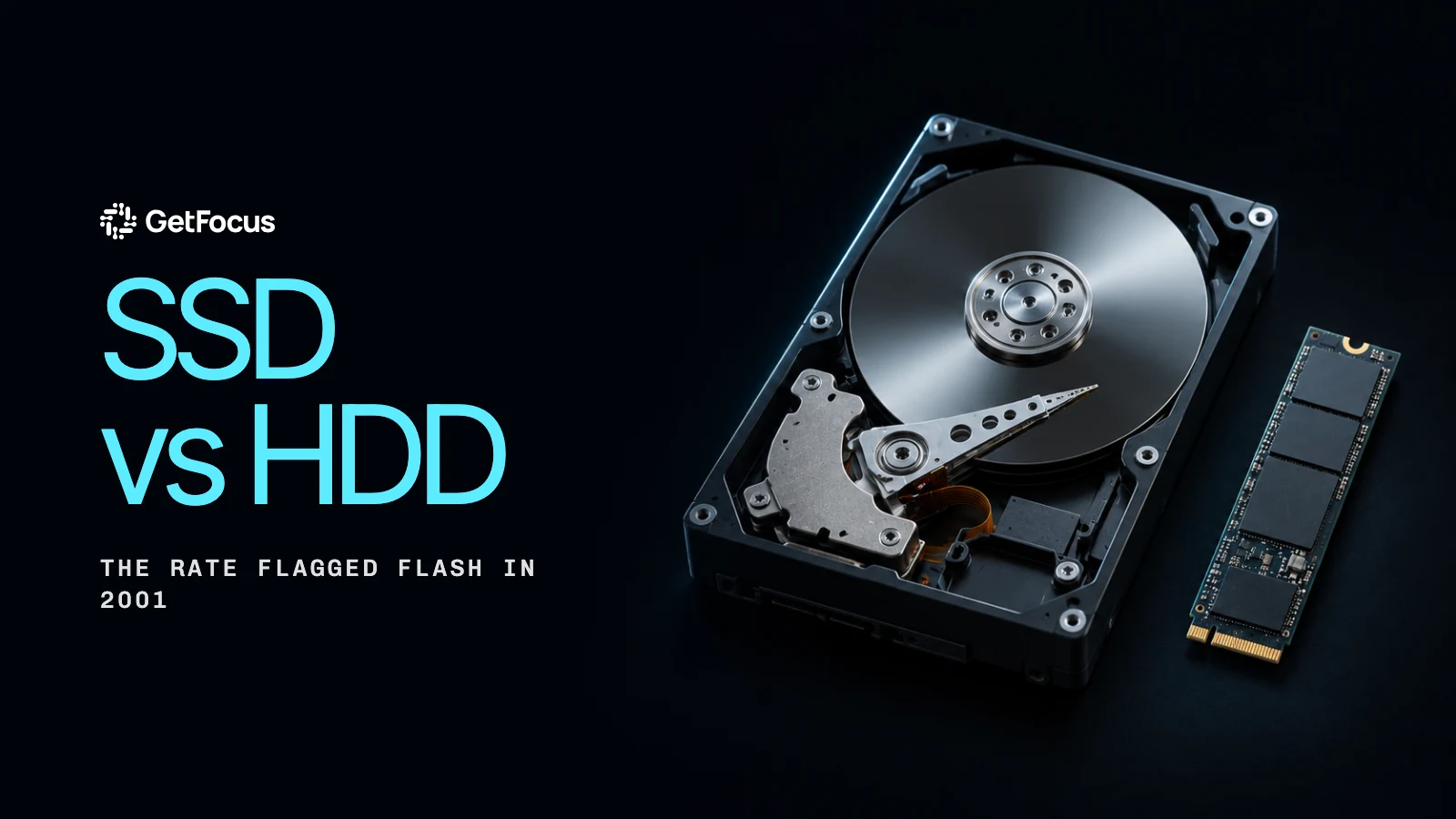
SSD vs HDD has a short answer: put an SSD in anything you work on, because it moves data several times faster and has no moving parts, and keep hard drives for bulk storage and backups, where they cost far less per gigabyte. At data-centre scale the gap is wide: in August 2026 a 30 TB enterprise SSD cost 18.6 times as much as a 30 TB hard drive, so both technologies still earn their place.
The patent record adds a date to that answer. We build GetFocus, which measures how fast technologies improve from the way patents cite each other. Replayed with only the patents that were public at each date, solid-state storage was improving at 49.6% a year in 2001 against 29.2% for hard drives, while hard drives logged almost six times as many new patent families. The full series is on the storage backtest page.
SSD vs HDD: which is faster?
The SSD, by a wide margin. AWS's comparison of the two puts hard drives at 30 to 150 MB per second for file transfers, SSDs at upwards of 500 MB per second, and newer SSDs at up to 3,500 MB per second.
The cause is mechanical. In AWS's description, a hard drive stores data on platters that spin at 4,200 to 7,200 revolutions per minute, and an actuator arm has to travel to the right track before anything is read. An SSD stores data in flash memory and reads it electronically, which removes that mechanical wait.
What does an SSD cost per GB compared with an HDD?
More, and in 2026 much more than a year ago. The long-run series from Our World in Data, built on John McCallum's price records and expressed in constant 2020 dollars, shows the gap closing over a decade:
- 2013: SSD about $694 per terabyte, hard disk about $41. A gap of 17 times.
- 2023: SSD about $26 per terabyte, hard disk about $11. A gap of 2.4 times, or roughly 2.6 cents against 1.1 cents per GB.
Then the gap widened. VDURA's Flash Volatility Index, reported by Blocks and Files on 11 August 2026, priced a 30 TB enterprise TLC SSD at $22,600 and a 30 TB hard drive at $1,216. That is a multiple of 18.6, up from 7.0 a year earlier, and it works out to about 75 cents against 4 cents per GB (our arithmetic). Consumer drives rose too: Notebookcheck, citing Tech Insider, reported a 1 TB Samsung 990 Evo Plus listed at $237 against an earlier low of about $59, and an average of about $144 for a 1 TB Gen4 NVMe SSD in mid-October 2026. It attributed the rise to an AI-driven shortage of NAND flash.
For consumer drives the gap is narrower. A price pull from Amazon US on 31 October 2026 listed the WD Blue 8 TB desktop hard drive at $309.99, or $38.75 per TB. Beside the $144 average for a 1 TB SSD, that is about 4 cents against 14 cents per GB (our arithmetic, across two sources and two dates).
These sources measure different baskets, so read them as snapshots. Each one says the same thing for a buyer today: capacity is cheapest on hard drives.
Which lasts longer, an SSD or an HDD?
In Backblaze's public field data, the two are close. Backblaze, a cloud storage company, measured an annualized failure rate of 1.36% across 344,196 hard drives in 2025. Its last SSD report put the lifetime failure rate of its 3,144 SSD boot drives at 0.90% through mid-2023. Backblaze itself called 63 failed SSDs a small sample, and its SSDs serve as boot drives, a different job from the data drives behind the hard-drive figure.
The failure modes differ. A hard drive's moving parts make it vulnerable when dropped. An SSD has no moving parts, and each of its memory blocks can be rewritten a finite number of times. For a laptop that travels, that favours the SSD.
When did the patent record show flash would win?
From the first reading in the backtest, in 2001. An improvement rate works like an interest rate on performance: a technology improving 50% a year compounds past one improving 29%, wherever each one starts. Filing volume shows where an industry's money and attention sit.
In 2001 the two charts disagreed. Hard drives logged 3,316 new patent families against 580 for solid-state storage. These are the rate readings from the GetFocus storage backtest, in improvement per year:
- 2001: SSD 49.6%, HDD 29.2%
- 2005: SSD 66.4%, HDD 31.0%
- 2010: SSD 71.9%, HDD 31.5%
- 2015: SSD 76.4%, HDD 34.0%
- 2026: SSD 58.7%, HDD 33.7%
Take the 2001 line. At 49.6% against 29.2%, solid-state doubles its performance relative to hard drives about every five years (our arithmetic, as an illustration; the rates moved from year to year). Hard drives read between 29% and 34% in all five readings, and solid-state read at least 20 points above them each time.
The filings took nine years to agree: solid-state out-filed hard drives for the first time in 2010. By 2026 the 2001 picture had inverted, at 3,172 solid-state families against 383.
The two signals under the rate explain the gap. Both technologies moved from one generation of inventions to the next at a similar pace. The difference sat in knowledge flow, a measure of how much later inventions build on earlier ones: solid-state's roughly doubled, from 0.8 toward 1.7, while magnetic storage stayed between 0.3 and 0.8. The method page describes both signals and the validation, on more than 150 technology domains.
Why did storage engineers keep backing hard drives?
Their arguments were true on the day they were made. Flash did cost far more per gigabyte: in the Our World in Data series, a terabyte of flash memory cost about 255 times a terabyte of disk in 2003. Flash did wear out with rewriting. And the hard-drive roadmap kept delivering: the backtest page lists perpendicular recording as delivered and heat-assisted recording as the promise of decades more.
Each argument described the present. The rate described the speed at which the present was changing. By 2023 the SSD price gap in the same Our World in Data dataset was down to 2.4 times, and for bulk storage the cost argument still holds in 2026. Consumer devices moved early. On 7 September 2005 Apple discontinued the iPod Mini, which stored music on a miniature hard drive, and replaced it with the flash-based iPod Nano.
What did arriving late cost Western Digital?
Western Digital's first step into flash was small. On 27 March 2009 it completed the purchase of SiliconSystems, a maker of solid-state drives for embedded systems, for $65 million in cash. The rate had been reading in favour of solid-state for eight years by then.
The large step came on 21 October 2015, when Western Digital agreed to buy SanDisk in a deal valued at about $19 billion, fourteen years after that first reading. The deal closed on 12 May 2016, and Western Digital's annual report records an aggregate purchase price of $15.59 billion. The two purchases differ by a factor of about 240 (our arithmetic), and they bought companies of very different size.
Of at least 218 companies that have made hard drives since 1956, three survive: Seagate, Toshiba and Western Digital. On 21 February 2025 Western Digital separated its flash business again, as Sandisk.
What are the limits of this reading?
The improvement rate is directional. It shows which technology is closing and roughly how fast, and it leaves prices to supply and demand. 2026 is the example: solid-state still improves faster, at 58.7% a year against 33.7%, and the enterprise price gap still widened to 18.6 times within a year.
The rate also leaves room for the slower technology to keep a market. Hard drives remain the cheaper home for bulk data in 2026, a quarter of a century after the first reading. And the backtest reads patents only, so progress kept as a trade secret stays outside it.
What does SSD vs HDD mean for an R&D leader?
For nine years the filing majority sat with hard drives while the rate read the other way. Three checks carry over to any portfolio:
- List every competing technology for the job your customers pay for, including the ones that look uneconomic today.
- Compare their improvement rates before you compare their filing volumes. Our article on how to compare competing technologies objectively walks through the yardsticks.
- Price the early move against the late one. Western Digital's two purchases are the worked example in invest now or wait.
Our article on how to backtest a forecasting method explains the replay. Running that comparison across every option for one technical problem is what technology forecasting software is for.
FAQ
Is an SSD faster than an HDD?
Yes. AWS's comparison puts hard drives at 30 to 150 MB per second for file transfers, SSDs at upwards of 500 MB per second, and newer SSDs at up to 3,500 MB per second. A hard drive has to spin a platter and move an arm to reach data, and an SSD reads it electronically.
Do SSDs last longer than HDDs?
Backblaze's field data puts the two close. It measured a 1.36% annualized failure rate across 344,196 hard drives in 2025, and a 0.90% lifetime rate on 3,144 SSD boot drives through mid-2023, a sample it called small. SSDs survive drops better because they have no moving parts, and their memory blocks accept a finite number of rewrites.
Why are SSDs so expensive in 2026?
Flash prices rose sharply over the year to August 2026. VDURA's index, reported by Blocks and Files on 11 August 2026, priced a 30 TB enterprise TLC SSD at $22,600 against $1,216 for a 30 TB hard drive, a multiple of 18.6, up from 7.0 a year earlier. Notebookcheck attributes the rise to an AI-driven shortage of NAND flash.
When did SSDs overtake HDDs?
In the GetFocus storage backtest, solid-state storage improved faster than hard drives from the first reading in 2001, at 49.6% a year against 29.2%. New solid-state patent filings passed hard-drive filings in 2010. Western Digital agreed to buy SanDisk in October 2015 and closed the deal in May 2016 for $15.59 billion.
Is there a hard drive in your portfolio?
In 2001 hard drives led on filings, on cost per gigabyte and on roadmap, and the rate was already reading the other way. If you are weighing a technology that looks safe on those same measures, send us the decision. Get a free 48-hour Decision Brief: a first-pass radar of the competing options, their improvement rates and suggested triggers.