Stay ahead of the curve
Get exclusive insights delivered directly to your inbox. Join thousands of tech leaders.
TL;DR
- GetFocus's live radar (May 2026) reads that sodium-ion will not replace LFP by 2030 and is likely to disrupt LFP's cheapest segments sooner.
- Sodium-ion drew level with LFP on improvement rate in 2019 (71.0% against 70.7% a year), pulled far ahead from 2023, and reads 124.9% against 64.8% in the latest update.
- Today LFP leads on range, price and scale: up to 205 Wh/kg against 175 for sodium-ion (IEA), and sodium-ion still costs more per Wh by its own maker's figures (HiNa, April 2026). Sodium-ion leads in cold weather and uses no lithium.
- The rate gives a direction and leaves the date open. LFP out-improved NMC for a decade before the market moved in 2020–2021.
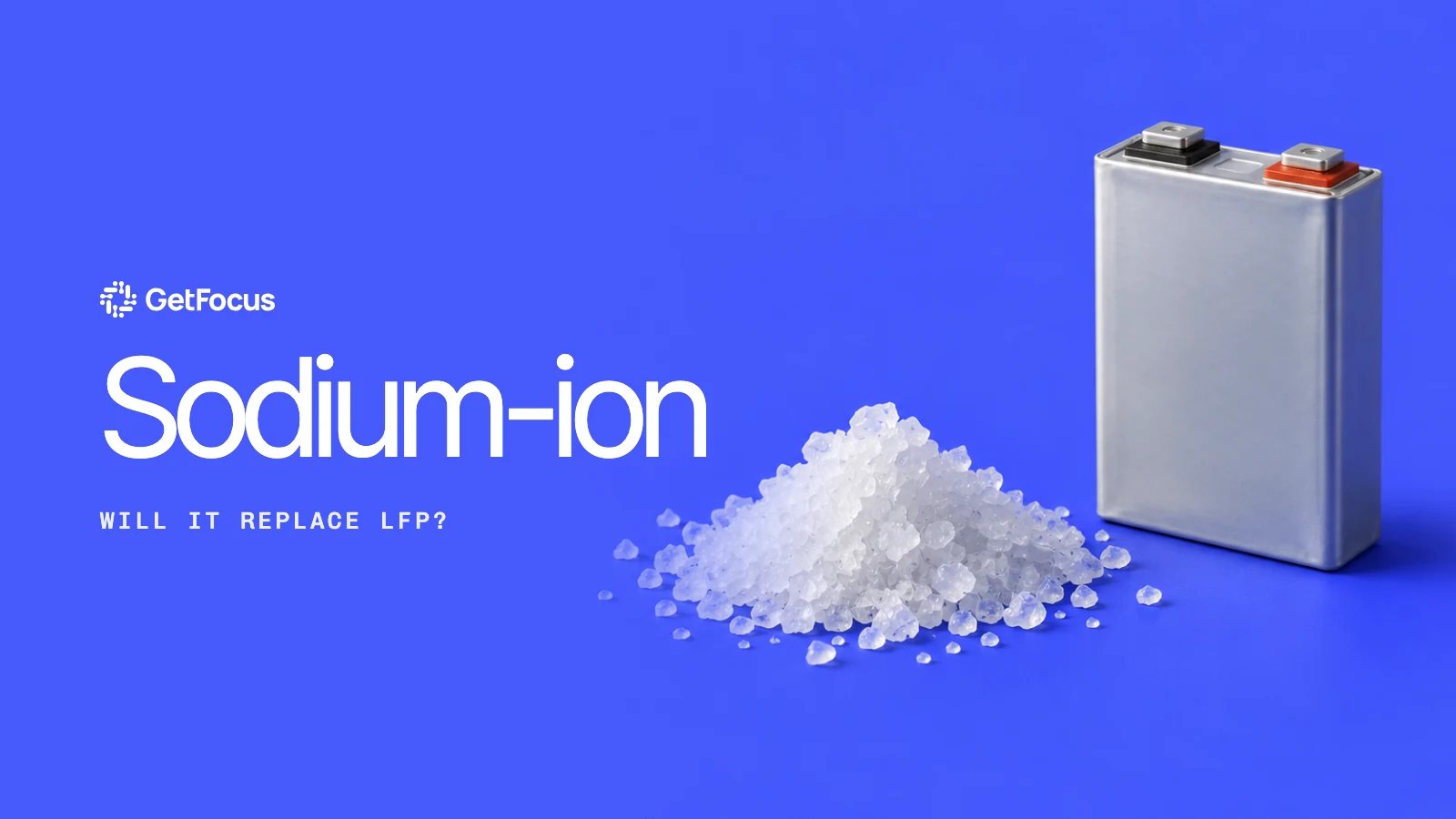
A sodium-ion battery will not replace LFP across electric cars by 2030, and it is likely to take LFP's cheapest segments sooner than that. This is the reading of GetFocus's live radar on EV battery chemistries (updated May 2026): sodium-ion drew level with LFP on improvement rate in 2019, pulled far ahead from 2023, and now reads 124.9% a year against LFP's 64.8%.
We build GetFocus, which measures how fast technologies improve from the way patents cite each other. The rates in this article come from that public radar, and every public figure links to its source. For an R&D leader with a battery roadmap, the practical question is when sodium-ion deserves pilot money, and which evidence would change the answer.
Sodium-ion vs lithium-ion: where do the two stand today?
LFP, short for lithium iron phosphate, is the lithium-ion chemistry that sodium-ion has to beat. It is the default for affordable electric cars: in 2025 LFP accounted for over 55% of EV batteries deployed globally, up from nearly 50% in 2024, according to the IEA's Global EV Outlook 2026. It is also cheap. BloombergNEF's 2025 survey put average LFP pack prices at $81 per kWh across all segments, against $128 for NMC, the nickel-manganese-cobalt family (BloombergNEF, December 2025).
A sodium-ion battery works the same way and swaps lithium for sodium. The same IEA chapter gives the current scorecard:
- Energy density. The latest sodium-ion cells reach up to 175 Wh/kg, compared with up to 205 Wh/kg for the latest LFP and 265 Wh/kg for NMC. The IEA says the gap is larger by volume, which gives an average SUV a driving range of up to 350 km, against 400 to 600 km with lithium-ion in average weather.
- Cold weather. Sodium-ion performs significantly better at low temperatures than lithium-ion, LFP in particular. The latest cells keep around 90% of nominal capacity at -40°C.
- Materials. Sodium-ion batteries use no lithium, and the IEA notes that sodium-ion capacity can help the largest battery makers reduce their exposure to lithium price spikes. Their anode is hard carbon in place of graphite, and the IEA calls the hard carbon supply chain poorly developed and largely concentrated in China.
- Scale. Sodium-ion cell manufacturing capacity equals just over 1% of lithium-ion capacity.
On cost, lithium-ion still leads. In remarks reported on 1 April 2026, the general manager of HiNa Battery, a Chinese sodium-ion maker, put sodium-ion at 0.5 to 0.7 yuan per Wh against 0.3 to 0.5 yuan for lithium-ion, and said he expects the two ranges to meet around 2027 (CarNewsChina, April 2026). On today's numbers LFP wins on range, price and scale, and sodium-ion wins on cold weather and raw materials.
What does the improvement rate say about the sodium-ion battery?
The improvement rate is how much a technology's performance improves per year. It works like an interest rate: each year's gain builds on the last. GetFocus reads it from how patents build on each other, using two citation measures: how quickly one generation of inventions follows the previous one, and how much later work builds on each invention (the method page shows both).
The radar reports these readings for sodium-ion against LFP in passenger electric vehicles:
- 2019: sodium-ion 71.0% a year, LFP 70.7%. The two drew level.
- 2022: sodium-ion 91.6%.
- From 2023: sodium-ion 124.9%, while LFP settled at 64.8%.
The radar compares six battery routes in total and turns each reading into an action. Sodium-ion, at about 125% a year and a technology readiness level of 8, gets the verdict "fund", with the advice to run pilots and map suppliers now. LFP and its manganese variant LMFP, at about 65% a year and readiness level 9, also get "fund": LFP is proven at scale, still improving, and the incumbent sodium-ion has to displace. Readiness and rate answer different questions, and our article on maturity versus momentum explains how to read the two together.
Think of two savings accounts. LFP's account holds far more money today, and sodium-ion's account pays a higher interest rate. As an illustration only: if 125% and 65% a year each held for three years, the first technology would end about 11 times better than it started and the second about 4.5 times better. Real rates move from year to year, as the list above shows, so read this as the direction of the gap.
Has a cheaper battery chemistry overtaken the leader before?
It has, and LFP was the challenger. The radar's history shows LFP improving faster than NMC for ten years before the market moved in 2020–2021. In 2015 LFP read 89.4% a year against NMC's 54.6%.
The market record since then is the IEA and BloombergNEF data above: LFP now supplies more than half of EV batteries, and its packs are priced more than a third below NMC packs. By our arithmetic, a team reading rates in 2015 had roughly five years of warning before the market moved in 2020–2021.
The sodium-ion case differs in one important way. LFP challenged a chemistry that costs more per kWh. Sodium-ion is challenging the chemistry that already won on cost, so it has to earn its place on cold-weather performance and lithium independence until its own cost comes down. Our article on comparing competing technologies objectively covers how to set up a comparison like this one.
So will sodium-ion replace LFP?
The radar's answer has two parts: sodium-ion will not replace LFP by 2030, and it is likely to disrupt LFP's cheapest segments sooner.
The public record points to the same segments. The IEA expects sodium-ion to suit small-range electric cars, light commercial vehicles in cities, two- and three-wheelers, industrial equipment and stationary storage, and notes that leading producers such as CATL and BYD are scaling it up. In February 2026 CATL and Changan unveiled a passenger car with CATL's Naxtra sodium-ion battery: up to 175 Wh/kg, a 45 kWh pack, up to 400 km of range and, at the time, a market launch planned for mid-2026 (CnEVPost, February 2026).
For long-range and premium cars, the energy density gap still favours lithium-ion. For a short-range city car sold in a cold climate, sodium-ion is already a credible option, and its rate suggests the list of such cases will grow.
What are the limits of this reading?
- The 2019 reading is a tie. The improvement rate is an estimate from citation patterns and it is directional. A reading of 71.0% against 70.7% is too close to call. The clear signal is the gap that opened afterwards: 91.6% in 2022, then 124.9% against 64.8%.
- It gives a direction and leaves the date open. LFP out-improved NMC for a decade before the market moved. Cost and supply chains set the timing.
- Realised cost still favours LFP. The cost crossover around 2027 is a manufacturer's forecast, and the IEA notes that lower energy density limits sodium-ion's competitiveness with LFP at current lithium prices.
- It covers passenger cars. The patent set behind the sodium-ion reading excludes filings aimed only at stationary storage, as the method page shows. Grid storage is a separate contest, and this reading does not cover it.
- Hard carbon can slow everything. The radar names the hard carbon anode as the control point for sodium-ion, and the IEA reports that its supply chain is immature.
What should an R&D leader do with this now?
- Pick the segments where energy density is a secondary constraint, such as small-range cars, urban vans and cold-climate vehicles, and run sodium-ion pilots there.
- Map sodium-ion cell suppliers together with their access to hard carbon.
- Write down the evidence that would move the decision. The radar names three thresholds: sodium-ion pack cost reaching parity with LFP, a second major carmaker adopting sodium-ion in a standard-range platform, and a shift in the improvement rate or supplier scale of hard-carbon precursors.
- Keep improving the LFP line. It is still compounding at about 65% a year.
Our article on whether to invest now or wait shows how to turn thresholds like these into a roadmap, and the technology forecasting software page shows how the reading is produced.
The same check works outside batteries: look for the challenger that still loses on today's numbers and improves faster than the incumbent. Send us one live technology decision and get a free 48-hour Decision Brief: a first-pass radar of the competing options and their improvement rates.
FAQ
Is a sodium-ion battery better than a lithium-ion battery?
It depends on the job. The IEA's Global EV Outlook 2026 reports that the latest sodium-ion cells reach up to 175 Wh/kg against up to 205 Wh/kg for LFP and 265 Wh/kg for NMC, so lithium-ion still gives more range. Sodium-ion uses no lithium and performs significantly better at low temperatures, which suits small-range cars, urban vans and cold climates.
Are sodium-ion batteries cheaper than LFP?
Today lithium-ion is cheaper, and LFP is its low-cost chemistry. In remarks reported in April 2026, the general manager of HiNa Battery put sodium-ion at 0.5 to 0.7 yuan per Wh against 0.3 to 0.5 yuan for lithium-ion, and said he expects the two ranges to meet around 2027 (CarNewsChina). That date is a manufacturer's forecast.
Which cars use sodium-ion batteries?
The IEA dates the first sodium-ion electric car to late 2023 in China. In February 2026 CATL and Changan unveiled a passenger car with CATL's Naxtra sodium-ion battery: up to 175 Wh/kg, a 45 kWh pack, up to 400 km of range and, at the time, a market launch planned for mid-2026 (CnEVPost).
When will sodium-ion replace LFP?
GetFocus's live radar reads that sodium-ion will not replace LFP across electric cars by 2030 and is likely to take LFP's cheapest segments sooner. Sodium-ion's improvement rate drew level with LFP's in 2019, pulled far ahead from 2023, and reads 124.9% a year against 64.8% in the May 2026 update. The rate gives the direction, and the date depends on cost, supply and adoption by carmakers.