Stay ahead of the curve
Get exclusive insights delivered directly to your inbox. Join thousands of tech leaders.
TL;DR
- What is technology scouting? The targeted search for technologies outside your organisation that could solve a specific problem, followed by a first assessment of which are worth pursuing.
- How does it differ from technology forecasting? Scouting finds the options. Forecasting estimates how good each option will become, and when. A sound decision needs both.
- Who does it? Dedicated scouts in central R&D or innovation teams, engineers in the business units, outside scouting services and, increasingly, software platforms.
- Where does it break down? Long lists with no defensible ranking, a pull towards familiar suppliers and technologies, and little follow-up once the report is filed.
- What is the step most teams skip? Measuring each option's maturity and improvement rate before the shortlist, so the ranking rests on evidence instead of familiarity.
Technology scouting is the targeted search for technologies outside your organisation that could solve a specific problem or open a new opportunity, followed by a first assessment of which are worth pursuing. Scouts search patents, research, startups, suppliers and other industries, and hand the business a long list of options.
For R&D leaders, scouting is where most technology decisions start. This guide explains how it works, who does it, how it relates to scanning, monitoring and forecasting, and where it tends to break down.
What is technology scouting?
Definitions vary in wording but agree on the substance. In Rohrbeck's study of scouting at European telecom incumbents, including Deutsche Telekom, firms "assign part of their staff or employ external consultants" to gather information on science and technology and connect it to the business. The US Department of Homeland Security describes scouting as "identifying, locating, and evaluating existing or developing technologies, products, services" and emerging trends. Oxford University Innovation (formerly Isis Innovation) defines it as "identifying and evaluating technologies in the research base".
Three features set scouting apart from general reading of the field:
- It starts from a need. A scout looks for answers to a specific problem or opportunity, often brought by a business unit.
- It looks outside. Universities, startups, suppliers, government labs and other industries are the hunting ground.
- It produces something the business can use. Typical outputs are technology profiles, scouting reports and rapid assessments. Deutsche Telekom's scouts wrote a "technology one-pager" for each find, feeding a radar that gave managers an overview of about 60 technologies.
Three kinds of technology scouting
Most scouting work falls into one of three kinds. They answer different questions, so it pays to know which one you are commissioning.
| Kind | The question it answers | Where scouts look | Typical output |
|---|---|---|---|
| Startup scouting | Who could we partner with, invest in or buy? | Startup databases, accelerators, venture networks, events | A shortlist of companies |
| Technology-route scouting | Which technical approaches could do this job? | Patents, papers, suppliers, adjacent industries | A map of competing routes |
| Patent-based scouting | Who is inventing what, and where is the activity? | Patent databases and citation data | Landscapes, inventor and owner lists |
Startup scouting is what many people mean by innovation scouting: finding young companies with something to offer, then deciding whether to partner, license, invest or acquire.
Technology-route scouting steps back from companies to approaches. Our analysis of fourteen routes to low-carbon ethylene is an example: electrochemical, catalytic, electrified and conventional routes all compete for the same job.
Patent-based scouting uses the patent record to find who is working on a problem and how the field is moving. Patents are early and global, which makes them a strong first source. Read them through citations rather than counts; our guide to using patent trends to forecast emerging technologies explains why.
Who does technology scouting?
Dedicated scouts. Large R&D organisations often keep a small team of scouts, sometimes in innovation hubs close to startup and university clusters. Studies of good scouts describe lateral thinkers who are scientifically knowledgeable, respected internally and comfortable across disciplines. Workload matters: Olivier de Weck's textbook on technology roadmapping advises that a scout should "not work on more than seven or so requests at once".
Engineers and technical experts. Many scouting requests are answered by specialists in the business units, using their own networks.
Technology scouting companies and services. Consultancies, specialist scouting firms, university technology-transfer offices and open-innovation networks all sell scouting, either as one-off searches or as an ongoing service.
Software platforms. Databases of patents, papers and startups widen the search and speed up the long list. Our 2026 comparison of R&D intelligence tools groups them by the job they do.
The role also changes with experience. In a case study by Felipe Monteiro of INSEAD, a telecom company's Silicon Valley scouting unit evolved over seven years from channelling information back to headquarters to translating, match-making and reshaping how problems were defined.
How technology scouting fits with scanning, monitoring and forecasting
These terms overlap, and organisations use them differently. Fraunhofer IPT draws a useful line: scanning is a constant, mostly undirected search of the environment; monitoring is closer tracking of specific fields; and scouting is a rapid, detailed search for a specific client or question. All three sit inside technology intelligence.
Forecasting answers a different question. The US National Research Council defines technology forecasting as "the prediction of the invention, timing, characteristics, dimensions, performance, or rate of diffusion" of a technology. Horizon scanning, by contrast, is "not about predicting the future", in the words of the US National Academies; it looks for early signs of change.
Where scouting sits in a technology decision
- 01ScanWhat is changing in our field and in the fields next to it?Output: signals
- 02ScoutWhich technologies could solve this specific problem?Output: a long list of options
- 03MeasureHow mature is each option, and how fast is it improving?Output: TRL and improvement rate
- 04DecideWhich options do we fund, watch or drop?Output: Fund, Monitor, Phase out or Ignore
- 05MonitorHas anything moved since we decided?Output: verdicts to revisit
In practice, a technology decision passes through all of these stages. Scanning raises the signal, scouting builds the list of options, measurement establishes how mature each option is and how fast it is improving, the decision sorts them, and monitoring checks whether anything has moved.
How a technology scouting project runs
A scouting project usually moves through four stages, which Deutsche Telekom's scouting process named identification, selection, assessment and dissemination. The time horizon shapes the method: NASA's 2023 review of scouting practice distinguishes near-term gap filling (1–5 years), incubating answers to known needs (5–10 years) and horizon scanning (10+ years).
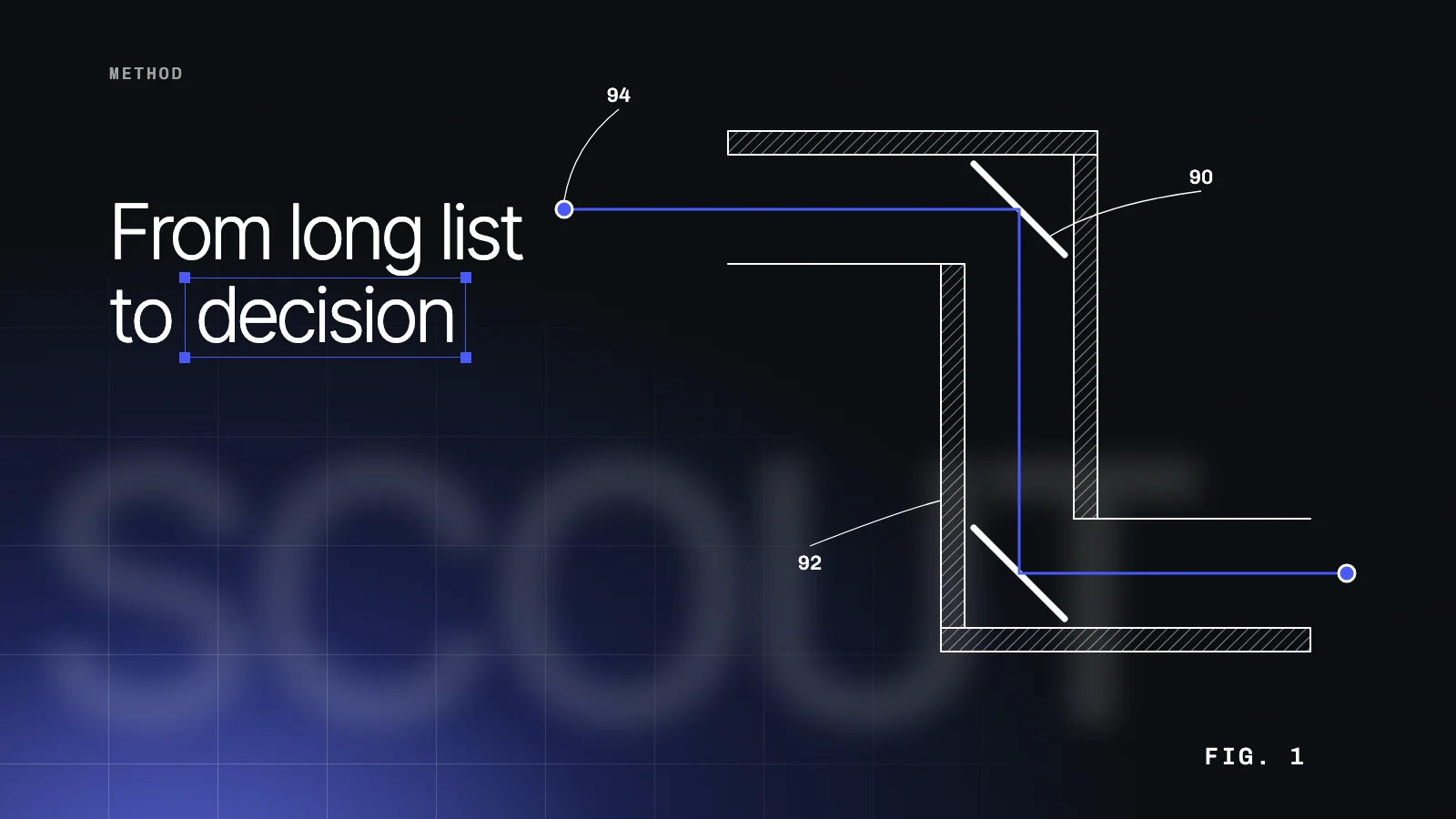
The hard part is the narrowing. Christophe Perthuisot, former SVP of R&D at Moët Hennessy, describes the job as getting from a hundred candidate technologies to the four or five worth examining. Our six-step technology scouting process shows how to do that, from framing the decision to re-checking every quarter.
Where technology scouting breaks down
Scouting is easy to start and hard to finish. The research and our own interviews with R&D leaders point to four failure points.
- Too many options, too little ranking. Monteiro found that idea-hunting mandates "can leave the company inundated with possibilities", with scouts sometimes following headquarters' requests blindly. Christophe Perthuisot describes how the options in front of an R&D team grew from a handful of routes to hundreds, from startups, academia and suppliers.
- Labour-intensive and unmeasured. NASA's 2023 benchmark of scouting practice found it "generally organic and highly labor-intensive", with findings rarely shared and many organisations tracking no metrics at all. Monteiro and Birkinshaw note that many multinationals have set up overseas scouting units, "but with mixed outcomes".
- The familiar wins. Established firms fall into what Ahuja and Lampert call the familiarity trap, "favoring the familiar" over the new. The not-invented-here effect makes it worse: Katz and Allen found the performance of R&D project groups declining as long-tenured teams cut themselves off from outside information. R&D leaders we interviewed in 2025 described a similar echo chamber: scouting that kept returning "the usual five vendors".
- A list without a rate. Most shortlists rank options by maturity, cost today and expert judgement. None of these says how fast an option is improving. Reflecting on a long-running technology bet on our podcast, Christophe Perthuisot put it plainly: "It was the right bet in the end — but it could just as easily have been the wrong bet. We had no easy way to know how quickly these technologies would progress."
Better foresight pays. In a longitudinal study of 83 European multinationals, Rohrbeck and Kum found only 36% adequately prepared for future change in 2008; those "vigilant" firms later showed 33% higher profitability and 200% higher market-capitalisation growth than the average. The study covers corporate foresight broadly, of which scouting is one part.
The step most teams skip: rank by maturity and improvement rate
Before the shortlist, measure two numbers for every option on the long list.
- Maturity. The technology readiness level (TRL) scale, conceived at NASA in 1974 and set at nine levels in the 1990s, runs from basic principles observed (TRL 1) to a proven system in operation (TRL 9). It tells you where an option is today.
- Improvement rate. The annual rate at which the option's performance per unit of cost is improving. It tells you where the option is going, and it can be measured; our explainer on why technology improvement is predictable shows how.
Plot both, and every option lands in one of four places:
- Fund what is mature and improving fast.
- Monitor what is immature but improving fast.
- Phase out what is mature but improving slowly.
- Ignore what is immature and improving slowly.
In the ethylene analysis, electrochemical CO₂-to-CO was improving at 43.6% a year against 13.0% for conventional steam cracking. A maturity chart alone would have ranked the electrochemical route well below the incumbent.
In GetFocus, scouting happens inside the platform: it maps the routes that could do a job, measures each route's maturity and improvement rate, and gives each one a verdict. The method page explains how.
Technology scouting companies, services and software
Most R&D organisations combine three sources:
- An in-house team for continuous scouting tied to the roadmap.
- Scouting services for one-off deep dives, specialist networks or extra capacity.
- Software to widen the search and keep the long list current.
Whichever you use, four questions separate a useful scouting partner from a long-list generator:
- Does it rank options, or only list them?
- Can it show how each ranking was made?
- Does it measure improvement, or count activity such as filings, funding and news?
- How often does it re-check its answer?
FAQ
What is technology scouting?
Technology scouting is the targeted search for technologies outside an organisation that could solve a specific problem or open an opportunity, followed by a first assessment of which are worth pursuing. Scouts search patents, research, startups, suppliers and other industries.
What is the difference between technology scouting and technology forecasting?
Technology scouting finds the options that could do a job. Technology forecasting estimates how each option will perform in future, for example how fast its performance per dollar will improve and when it will overtake the incumbent. Scouting builds the list; forecasting ranks it.
What is innovation scouting?
Innovation scouting is often used interchangeably with technology scouting. When the terms are separated, innovation scouting is broader: it covers startups, business models and partners as well as technologies.
How long does a scouting project take?
There is no reliable benchmark. NASA's 2023 review found that many organisations do not track scouting metrics at all. Duration depends mostly on scope: a single, well-framed question moves far faster than an open-ended landscape. A GetFocus Decision Brief maps the competing routes for one decision in 48 hours.
How is patent data used in technology scouting?
Patent data shows who is inventing what, where and how fast. Scouts use it to find routes and owners they would otherwise miss, and citation patterns show which routes are improving fastest. Counting patents shows activity, which is a weaker signal.
Which AI-driven patent tools do experts recommend for technology scouting?
It depends on the job. For finding patents and prior art, teams use Google Patents (free) and The Lens (free for public use), or PatSnap, Derwent Patent Search and IPRally. For startups and partners, ITONICS and Wellspring Scout. To rank the routes a scout finds by improvement rate and maturity, GetFocus. Our 2026 comparison covers 18 tools.
Turn your long list into a decision
Bring us one technology decision you are weighing. Within 48 hours, a free Decision Brief maps the competing routes by improvement rate, so you know which options deserve the next round of work.
Sources
- Rohrbeck, R. (2010). Harnessing a network of experts for competitive advantage: technology scouting in the ICT industry. R&D Management, 40(2), 169–180. doi.org/10.1111/j.1467-9310.2010.00601.x
- US Department of Homeland Security, Science and Technology Directorate. Technology Scouting. dhs.gov
- Oxford University Innovation. Technology Scouting Services. innovation.ox.ac.uk
- de Weck, O.L. (2022). Technology Scouting. In Technology Roadmapping and Development, ch. 14. Springer. doi.org/10.1007/978-3-030-88346-1_14
- Monteiro, L.F. (2015). Generate more value from your external knowledge sourcing. INSEAD Knowledge. knowledge.insead.edu
- Monteiro, F. and Birkinshaw, J. (2017). The external knowledge sourcing process in multinational corporations. Strategic Management Journal, 38(2), 342–362. doi.org/10.1002/smj.2487
- NASA Office of Technology, Policy and Strategy (2023). Technology Scouting Phase 1 Report. ntrs.nasa.gov
- Ahuja, G. and Lampert, C.M. (2001). Entrepreneurship in the large corporation. Strategic Management Journal, 22(6–7), 521–543. doi.org/10.1002/smj.176
- Katz, R. and Allen, T.J. (1982). Investigating the Not Invented Here (NIH) syndrome. R&D Management, 12(1), 7–20. doi.org/10.1111/j.1467-9310.1982.tb00478.x
- Rohrbeck, R. and Kum, M.E. (2018). Corporate foresight and its impact on firm performance: a longitudinal analysis. Technological Forecasting and Social Change, 129, 105–116. doi.org/10.1016/j.techfore.2017.12.013
- Fraunhofer IPT. Technology Intelligence. ipt.fraunhofer.de
- National Research Council (2010). Persistent Forecasting of Disruptive Technologies, ch. 2. nationalacademies.org
- National Academies of Sciences, Engineering, and Medicine (2020). Safeguarding the Bioeconomy, ch. 6. nationalacademies.org
- Banke, J. (2010). Technology Readiness Levels Demystified. NASA. nasa.gov
- GetFocus podcast: Christophe Perthuisot on technology bets. getfocus.eu/podcast