Stay ahead of the curve
Get exclusive insights delivered directly to your inbox. Join thousands of tech leaders.
TL;DR
- The clearest public figure for a platform licence: £223,512 excluding VAT for one year, 100 users with 10 concurrent logins and an API data feed (UK Research and Innovation, Find a Tender, November 2024, a direct award).
- A report series: a contract valued at £98,275 to continue a technology horizon-scanning report for three new editions (Sellafield, September 2025). A four-year technology watch framework: capped at €800,000 (European Defence Agency, May 2026).
- Five pricing models: per seat, package, usage, fixed fee per technology area, assessment or report series. Make every vendor quote the same scope for 12 months.
- The costs outside the quote decide the case: your team's hours, and the price of backing the technology that loses.
The clearest public answer to what technology intelligence software costs a large organisation is a contract notice: UK Research and Innovation awarded a contract valued at £223,512, excluding VAT, for one year of a patent analytics platform for 100 users, with 10 concurrent logins, plus an API data feed (Find a Tender, November 2024). The vendor pricing pages we read on 20 November 2026 list plans and no amounts, so your own figure depends on the pricing model and on the scope behind the quote.
The short version:
- A platform licence: £223,512 for one year, 100 users with 10 concurrent logins and an API data feed, in the one public contract we found, a direct award.
- A report series: a contract valued at £98,275 to continue a technology horizon-scanning report for three new editions (Find a Tender, September 2025).
- A continuous watch bought as a service: a four-year framework capped at €800,000 (TED, May 2026).
- The cost that decides the case: your team's hours, and the price of backing the technology that loses.
We build GetFocus, which measures how fast technologies improve from the way patents cite each other. Our own subscription is priced per domain and the product page shows no amount, so this article gives no GetFocus price.
How much does a technology intelligence platform cost for a large company?
Three public contracts give dated figures. All three buyers are public bodies, which have to publish what they award.
- Per-seat platform. UK Research and Innovation bought PatSnap's patent analytics for "100 users / 10 concurrent login" plus an API data feed, valued at £223,512 excluding VAT. It was a direct award with one tender received. The dates in the notice clash: it was published on 26 November 2024 and records the contract as concluded on 25 November 2024, yet it prints the period as 26 November 2025 to 25 November 2026. Either way it covers one year. By our arithmetic that is about £2,235 per user, data feed included.
- Report series. Sellafield Ltd, the UK nuclear site operator, awarded Outsmart Insight a contract to continue production of its Tech Radar report and the research behind it for three new editions, with lists of notable organisations and short videos. The contract value is £98,275 excluding VAT and the contract dates are 8 September 2025 to 31 March 2026.
- Continuous watch as a service. The European Defence Agency awarded a framework for "Technology Watch and Landscaping" to three contractors, described as a regular, AI-supported assessment of technological developments. It runs 48 months with a maximum value of €800,000, which is a ceiling of €200,000 a year by our arithmetic.
IPRally's pricing page describes "per seat annual pricing" with discounts from three seats and a custom enterprise plan. ITONICS's pricing page lists Core, Pro and Enterprise packages with add-ons. Neither showed an amount when we read them on 20 November 2026. Our comparison of R&D intelligence tools concluded on 10 November 2026 that public product pages establish no comparable monetary price for the six offerings it covers.
Which pricing models does technology intelligence software use?
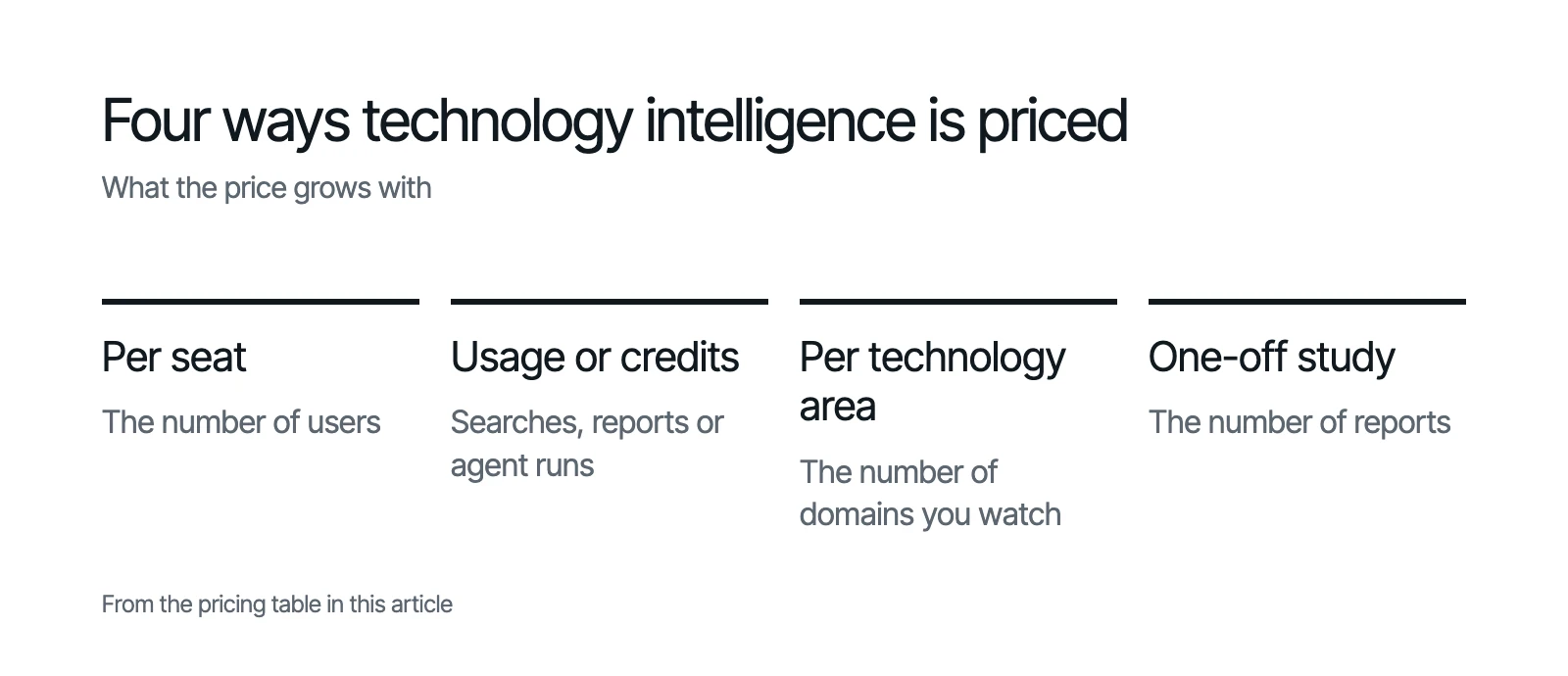
Five pricing models are worth telling apart, and four of them have a public example in the pages and notices we read. Each one scales with something different, and that is the number to check against your own plans.
| Pricing model | What the price scales with | Public example | What to check |
|---|---|---|---|
| Per seat | Named or concurrent users | £223,512 for a year, 100 users (10 at a time), API feed included (UKRI, November 2024). IPRally: per-seat annual pricing, no amount shown | Who needs a login, and whether occasional readers need a full seat |
| Package or tier | The tier, its user allowance and its add-ons | ITONICS: Core with 10 full users, Pro with up to 50, Enterprise with a custom number; no amount shown | Which tier holds the security and reporting features you need |
| Usage or credits | Volume of searches, reports or AI agent runs | We found no public example with a price | What happens when a busy quarter exceeds the allowance |
| Fixed fee per technology area | The number of domains you put under watch | GetFocus: annual subscription per domain, up to 50 technologies and five seats; no amount shown | How a domain is drawn, and what a second domain costs |
| Assessment or report series | The number of questions, reports or editions | Contract valued at £98,275 to continue the Tech Radar report for three new editions (Sellafield, September 2025) | What it costs to refresh the answer a year later |
Our guide to the RFP for technology intelligence software gives the rule for price: make every bidder quote the same scope, meaning the domains you will track for 12 months, the people who need access and the updates you expect.
What drives the price inside a quote?
Five factors move a quote.
- Data coverage. Patents only, or also papers, companies and market news. The UKRI contract bought three data products and an API feed in one line. Our guide to gathering competitive intelligence on R&D helps decide which sources your questions need.
- Analyst time. Software alone, or software with people who run the analysis and present it. ITONICS lists onboarding and consulting as services beside its packages. A GetFocus domain includes a quarterly executive review.
- Monitoring cadence. A snapshot, or a domain that is read again every month. The European Defence Agency framework sets a ceiling for a regular assessment over four years.
- Security and sign-on. On the ITONICS page, single sign-on comes with Core, while SCIM provisioning, multi-factor authentication and a test environment are listed under Enterprise.
- Integrations and AI access. ITONICS lists native integrations as an add-on. On IPRally's page a single-user plan has no API or MCP access, the route an AI assistant uses to query the platform, while Team and Enterprise plans include MCP access and system-to-system API access is scoped separately.
What does a one-off technology assessment cost, from a consultancy or from an AI-based provider?
We found no published price for a single assessment from either kind of provider. The nearest public marker is the Sellafield report series: a contract valued at £98,275 for three new editions, with contract dates about seven months apart. That is roughly £33,000 an edition by our arithmetic. A single study answers the question once, so plan for the cost of the refresh.
What we can state is our own first step: the GetFocus 48-hour Decision Brief is free. You bring one live technology decision and get back a first-pass radar and an improvement rate for each competing technology. Our article on turning a technology assessment into a board recommendation shows what the finished work should contain.
How much of your team's time does a tool need before it pays off?
The hours depend on who does the reading. A tool your team runs itself needs someone to write the searches, clean the results and turn them into a recommendation, and our article on whether a technology intelligence tool is worth renewing argues that this work is usually the largest hidden cost. We found no public benchmark in hours, so start a log in the first month and count net hours: time released minus time spent running and checking the tool.
With a managed service the input is smaller. For a GetFocus domain it is one strategic question in plain language, a sign-off on the list of competing technologies and the quarterly review. The product page puts scouting in weeks one and two and the first improvement rates in weeks two to four.
What does the wrong bet cost?
This is the largest line in the case. The business case for a technology intelligence subscription turns it into one sum: divide the annual fee by what a wrong call would cost, and you have the probability of being wrong at which the tool pays for itself. ILLUSTRATIVE: when the fee is 1% of the downside, a 1% chance of backing the wrong technology covers it.
Public history shows the scale. In our storage backtest, Western Digital's 2009 entry into flash was a reported $65 million, and in October 2015 it announced it would buy SanDisk for about $19 billion. Before you sign, ask the vendor to show its method on a shift your industry already lived through. Our guide to backtesting a technology forecasting method gives the steps.
What are the limits of these figures?
- Three contracts, all public buyers. They show an order of magnitude for the UK and the EU. A company's negotiated price can sit above or below them.
- Dates. Pricing pages were read on 20 November 2026. Contract values are as published, in their own currency, with no conversion.
- Who this applies to. R&D and strategy teams with technology bets that recur each year. For a single prior-art search or a literature check, a search tool or a report is the better purchase.
Send us one live technology decision and get a free 48-hour Decision Brief: a first-pass radar of the competing technologies and their improvement rates. It gives you a real output to hold next to every quote you receive.
FAQ
How much does a technology intelligence platform cost for a large company?
The vendors we checked quote on request, so the firm numbers come from public contracts. UK Research and Innovation awarded a contract valued at £223,512 excluding VAT for one year of PatSnap's patent analytics for 100 users, with 10 concurrent logins, plus an API data feed (Find a Tender, November 2024, a direct award). A company's own quote depends on the pricing model, the number of users or technology areas, and what is included.
What does a one-off technology assessment cost?
We found no published price for a single assessment, from a consultancy or from an AI-based provider. The nearest public marker is a report series: Sellafield Ltd awarded a contract valued at £98,275 excluding VAT to continue its Tech Radar horizon-scanning report for three new editions, with contract dates from September 2025 to March 2026 (Find a Tender, September 2025). GetFocus's first pass, the 48-hour Decision Brief, is free.
How much team time does a technology intelligence tool need?
It depends on who does the reading. A tool your team runs itself needs someone to write the searches, clean the results and turn them into a recommendation. A managed service asks for a question, a sign-off on scope and a regular review. We found no public benchmark in hours, so log your own from the first month.
Does GetFocus publish its price?
GetFocus publishes its pricing model and no amount. The Annual Domain Subscription is priced per domain: up to 50 technologies tracked and five platform seats. The first step, a 48-hour Decision Brief on one live decision, is free.