Stay ahead of the curve
Get exclusive insights delivered directly to your inbox. Join thousands of tech leaders.
TL;DR
- A rotary engine (the Wankel engine) makes power with a triangular rotor turning inside an oval housing, with no pistons, valves or camshaft.
- It faded from cars because of seal wear, high fuel and oil use and unburnt-fuel emissions. The 1973 oil embargo made those weaknesses decisive.
- GM paid $50 million for a licence in November 1970 and shelved the engine in September 1974. NSU, the company that first built it, was taken over by Volkswagen in 1969.
- GetFocus data from 1972 to 2026 shows the rotary engine improving at 4.8% to 5.8% a year while the piston engine went from 6.6% to about 13%. The challenger was behind at every reading.
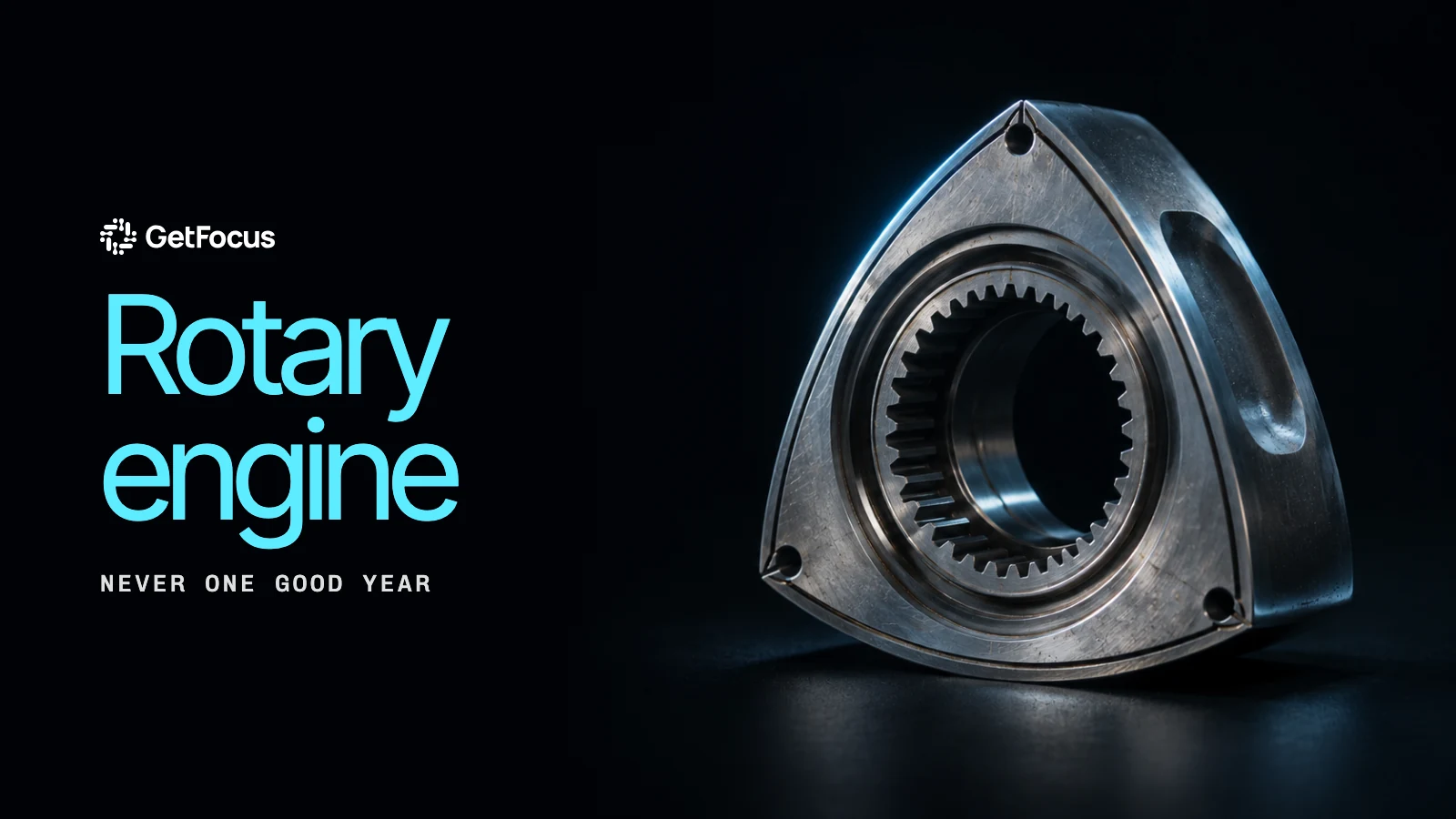
A rotary engine is a petrol engine that makes power with a triangular rotor spinning inside an oval housing, where a piston engine uses pistons moving up and down. It faded from cars because it burned more fuel and oil than piston engines, wore out its seals, and improved at 5% to 6% a year while the piston engine it was meant to replace went from 6.6% to 13% a year.
That last number is ours. We build GetFocus, which measures how fast a technology improves from the way its patents cite each other. On our rotary engine backtest, the data runs from 1972 to 2026, and the rotary engine trails the piston engine at every reading. General Motors paid $50 million for a licence two years before the first reading.
What is a rotary engine?
The rotary engine used in cars is the Wankel engine, named after the German engineer Felix Wankel. His first prototype ran on 1 February 1957 at the German carmaker NSU, according to the Wankel engine history on Wikipedia.
It does the same four jobs as the engine in an ordinary car: draw in air and fuel, compress the mixture, burn it, and push out the exhaust. The difference is the moving part. A piston engine turns the up-and-down motion of pistons into rotation through a crankshaft. A rotary engine rotates from the start, so it needs no valves, no camshaft and no connecting rods.
How does a rotary engine work?
Picture a rounded triangle turning inside a chamber shaped like a slightly pinched oval. The three tips of the triangle stay in contact with the chamber wall, which divides the space into three pockets. As the rotor turns, each pocket grows, shrinks and grows again.
- Intake. A pocket passes the intake port and expands, pulling in air and fuel.
- Compression. The rotor carries the pocket round and squeezes it against the wall.
- Combustion. Spark plugs ignite the mixture, and the expanding gas pushes the rotor on.
- Exhaust. The pocket reaches the exhaust port and the burnt gas leaves.
All three pockets do this in turn, so each rotor delivers one power pulse for every turn of the output shaft. The result is a small, light, smooth engine that is happy at high revs.
Why did carmakers bet on the rotary engine?
On paper it looked like the piston engine's successor: fewer moving parts, less vibration, more power from a smaller package. Between 1958 and 1973 the licence list grew to include Curtiss-Wright, Daimler-Benz, Mazda, Rolls-Royce, Porsche, Nissan, Toyota and General Motors, per the same Wikipedia history.
GM made the largest bet. In November 1970 it paid $50 million for its Wankel licences, roughly $400 million in today's money by the estimate on our backtest page. GM president Ed Cole projected a production engine in three years and took charge of the programme himself, with a first target of October 1973 as an option on the 1974 Chevrolet Vega (Wikipedia, General Motors Rotary Combustion Engine).
Why did the rotary engine fail?
The rotary engine failed in passenger cars for four reasons that all trace back to its shape.
- Seals. The strips at the three rotor tips, called apex seals, have to hold gas pressure while sliding along a wall that heats unevenly. Early ones wore fast.
- Fuel. The combustion pocket is long, thin and moving, with a lot of wall for its volume. The mixture burns slowly and incompletely, so more fuel goes in for the same work.
- Emissions. Incomplete burning leaves unburnt fuel in the exhaust, which became a problem once emission limits tightened.
- Oil. The seals are lubricated by feeding oil into the chamber, where it burns with the fuel.
The business consequences followed in order. NSU's Ro 80 was voted Car of the Year for 1968, and some early cars then needed a rebuilt engine before 50,000 km. The warranty bill and the damage to the car's name left NSU's finances beyond repair, and Volkswagen took the company over in 1969 (Wikipedia, NSU Ro 80).
GM carried on. It paid a further $10 million against its licence in December 1973, in the middle of the oil embargo, and announced a first delay. In September 1974 Ed Cole postponed the engine over emissions, GM admitted the fuel economy was below standard, and Cole retired the same month. The engine was shelved.
Of the big licensees, Mazda was the one that stayed. It launched its first rotary car, the Cosmo, in 1967, won the 24 Hours of Le Mans in 1991 with the four-rotor 787B, and built more than 1.99 million rotary vehicles before the RX-8 was discontinued in June 2012, by Mazda's own count.
How fast was the rotary engine improving?
This is the part of the story the 1970s boardrooms had no number for. An improvement rate says how much better a technology gets each year, the way an interest rate says how fast savings grow. GetFocus estimates it from two things in the patent record: how quickly one generation of inventions follows the last, and how much later inventions build on earlier ones. Every patent has a date, so the calculation can be rerun for any past year using only the patents that were public then.
Run that way, the piston engine and the rotary engine give these readings on our backtest page:
- 1972: piston 6.6% a year, rotary 4.8%.
- 1974: piston 8.1%, rotary 5.4%.
- 2012: piston 13.0%, rotary 5.5%.
- 2026: piston 12.8%, rotary 5.8%.
The gap between the two columns is the story, because a challenger has to improve faster than the incumbent to catch up, and in 1972 the rotary was already improving more slowly. A good year for the rotary would have been one in which it out-improved the piston engine, and the series contains none. Between 1972 and 2026 the piston engine's rate roughly doubled while the rotary's ended one percentage point above where it began. By 2012 Mazda's engineers were chasing a target that moved away from them more than twice as fast as they could move.
The two inputs explain why. The rotary's generations of invention sat about twenty years apart for half a century, and later patents built on rotary work only weakly. The piston engine's generations kept getting closer together. Meanwhile companies kept filing rotary patents, and that activity looked like progress to anyone watching the volume of work.
The rotary engine drew more licensees than any alternative engine, and its improvement rate stayed flat through all of it.
What this reading can and can't tell you
Our series opens in 1972, so it says nothing about the years when the licences were signed. GM's cheque came two years before the first reading; what the data shows is that every decision after 1972, including GM's second payment, was made against a rate that was already behind. The rate is also directional. It ranks competing technologies for the same job and says which one is pulling away, and it will not give you next year's fuel consumption figure. And it reads patents only. It did not see the oil embargo coming. For more on testing a method like this against history, see how to backtest a technology forecasting method.
Is the rotary engine still used today?
Yes, in a smaller role. In 2023 Mazda put an 830 cc single-rotor engine into the MX-30 e-Skyactiv R-EV, its first production rotary in eleven years. The engine drives a generator that charges the battery, and an electric motor drives the wheels. In that supporting role the engine's small size is what counts, and it no longer has to move the car on its own.
Your industry has a rotary engine somewhere
For an R&D leader, the useful part of this story is how sensible the bet looked. Three arguments carried it, and you may recognise them from your own technology reviews.
The first was that fewer moving parts must win. An elegant design tells you where a technology starts, and the rotary's starting point was excellent; what it lacked was the rate to pull away from there. The second was that everyone had licensed it. A long list of serious companies shows that a technology has attention. Whether it is improving is a separate question, which is the subject of our piece on expert bias in R&D decisions. The third was that racing proved it worked, and Le Mans in 1991 did prove what a rotary could do on one day. Markets are decided by cost and performance compounding year after year.
Somewhere in your portfolio there is a project with the same profile: a credible champion, respected partners, a strong demo, and a rate nobody has measured. The check takes three questions. What is the incumbent it has to beat? How fast is each one improving? Is the gap closing or widening? If the challenger improves more slowly than the incumbent, more funding buys more years of the same gap, which is the hardest moment to act on in a stage-gate review. The same comparison is what technology forecasting software should give you before the cheque is written.
FAQ
Why did the rotary engine fail?
It used more fuel and oil than piston engines, produced more unburnt hydrocarbons, and had seal wear problems in its early years. The 1973 oil embargo and tighter emission rules made those weaknesses decisive. In GetFocus data the rotary engine also improved more slowly than the piston engine at every reading from 1972 to 2026, so the gap widened.
Who invented the rotary engine?
Felix Wankel, a German engineer. He received his first rotary engine patent in 1934, joined NSU in 1951, and the first prototype ran there on 1 February 1957.
Does any car still use a rotary engine?
Mazda's MX-30 e-Skyactiv R-EV, launched in 2023, carries an 830 cc single-rotor engine that works as a generator for the battery. The last car driven directly by a rotary engine in mass production was the Mazda RX-8, discontinued in June 2012.
Could GM have known the rotary engine would fail?
In November 1970, when GM paid $50 million, our data series had not yet opened. From 1972 the improvement rate was readable from public patents: 4.8% a year for the rotary against 6.6% for the piston engine. GM paid a further $10 million in December 1973 and shelved the engine in September 1974.
Facing a bet like this?
Send us one live technology decision. Within 48 hours you get a free preliminary Decision Brief: a first-pass radar of the competing options, their improvement rates and the triggers worth watching. Get a free 48-hour Decision Brief.