Stay ahead of the curve
Get exclusive insights delivered directly to your inbox. Join thousands of tech leaders.
TL;DR
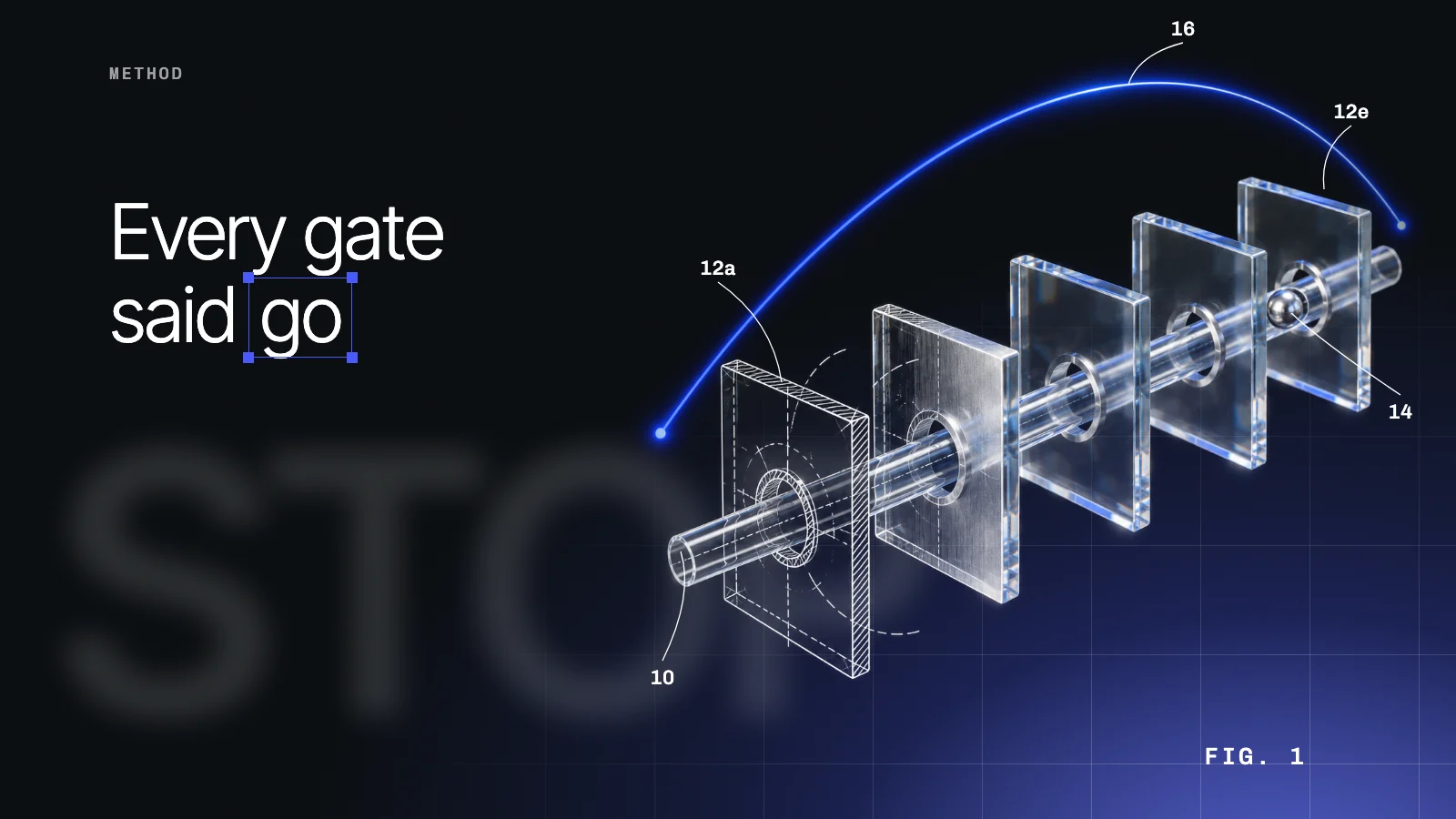
- The stage-gate process splits a project into stages separated by go/kill reviews. In practice the gates check schedule, budget and milestones, so they almost never say stop.
- The missing gate question: is a competing approach improving faster than ours? GetFocus measures that as the Technology Improvement Rate.
- GM's $50M rotary engine licence passed every internal test. The piston engine out-improved it in every year from 1972 to today.
- Stopping is not automatically right either. Pause with a trigger, so a restart is a plan, not a cold start.
What is the stage-gate process?
The stage-gate process is a project governance model. Work moves through stages, usually scoping, business case, development, testing and launch. Between stages a gate committee decides go, kill, hold or recycle. Robert Cooper formalised it in the 1980s and it remains the default in large R&D organisations, because it brings discipline and a shared language to execution.
What are the five stages of the stage-gate process?
- Scoping: a quick look at the opportunity and the technical approach.
- Business case: market, technical feasibility, financials and a project plan.
- Development: design and build of the product or process.
- Testing and validation: lab, field and customer trials.
- Launch: commercial roll-out and production.
Each stage ends in a gate review: the decision meeting where the committee looks at the deliverables and decides whether the project continues.
Why do stage-gates rarely kill projects?
Because every gate question looks inward. Is the project on time? On budget? Did it hit its technical milestones? What do our experts think? A project can answer yes to all four while the technology underneath it is losing.
Christophe Perthuisot, former SVP of R&D at Moët Hennessy and Danone, watched it happen to a programme he oversaw: ten years and tens of millions spent on a route the evidence had already turned against. "The signals were there. If you act on it, you may have to cut other projects. You cannot fund everything." (Read the story.)
Three forces keep a project alive after it should end:
| Force | What it sounds like | Why the gate misses it |
|---|---|---|
| Sunk cost | "We might be only €100,000 from the solution," after millions spent | The gate funds the next step, not the whole bet |
| Ownership | The sponsor has promised results to their own boss | Stopping reads as admitting a mistake |
| Inside-only evidence | On time, on budget, experts positive | Nothing in the review shows a rival route pulling ahead |
The third force is the one you can fix with data.
Backtest · Engines · 1972–2026
Every gate passed. The rate never moved.
GM licensed the Wankel rotary for $50M in 1970. The piston engine out-improved it in every year on record.
Improvement rate per year, computed from patents public at each date · GetFocus backtest: rotary vs piston
The project that passed every gate
In 1970 General Motors paid $50 million for a licence to the Wankel rotary engine, roughly $400 million today. On paper it was the piston engine's obvious successor: smooth, compact, few moving parts. Mercedes-Benz, Toyota and Curtiss-Wright had licensed it too. Every internal review would have said go.
The GetFocus backtest replays the rate using only the patents public at each date. From the first reading in 1972 the rotary improved at 4.8% a year against the piston engine's 6.6%. By 2012, when Mazda ended RX-8 production after 45 years, it was 5.5% against 13.0%. The rotary never had one good year. A gate that asked "is a competing approach improving faster than ours?" would have had its answer before the first prototype.
The one question to add at every gate
Add this to every stage-gate review, and answer it with evidence from outside the company:
Is a competing approach improving faster than ours, and by how much?
GetFocus measures that as the Technology Improvement Rate: the annual rate at which a technology's performance compounds, estimated from the patent citation network. A gap in rate is a gap in destination. Then add the follow-ups:
- Would we start this project today, knowing what we know now? If not, why are we continuing it?
- What would have to be true for it to win, and is it still true?
- If we stop, what do we keep? Patents, data, a small watch on the field, a partner.
- What would make us restart, and who is watching for it?
The opposite mistake: stopping too early
A kill is not automatically brave. Programmes are often paused because other priorities crowd in, not because anything changed in the technology. Restarting later is expensive: the team has dispersed, the knowledge has left with it, and a competitor may have filed in the gap.
The rate protects against both errors. A project whose technology is improving faster than its rivals deserves protection when budgets tighten. A project whose technology has stalled deserves a hard look however well it is executing. Questions 3 and 4 above turn a kill into a pause with a trigger: if the rate turns, you restart on evidence, not on a hunch.
Gates review projects. Portfolios need a radar.
A gate looks at one project. A portfolio review compares them. GetFocus places every competing technology in a domain on one TRL × TIR radar with four verdicts: fund, monitor closely, phase out, ignore. Positions move as new patents publish, so the portfolio review starts from what changed outside, not from the project list.
FAQ
What is a stage-gate review?
A stage-gate review is the decision meeting between two project stages. A committee reviews the deliverables of the stage just finished and decides go, kill, hold or recycle.
What are the main weaknesses of the stage-gate process?
It reviews projects one at a time on internal criteria: schedule, budget and milestones. It does not compare projects with each other, and it does not show whether a competing technology outside the company is improving faster.
What is the difference between a phase gate and a stage-gate?
The terms are used interchangeably. "Stage-Gate" is Robert Cooper's trademarked model; "phase-gate" is the generic name for the same idea of work phases separated by decision points.
How do you decide when to kill an R&D project?
Ask whether you would start it today, and whether a competing approach is improving faster than yours. If the first answer is no or the second is yes, the project needs a decision, not another stage.
Is it expensive to restart a stopped R&D project?
Usually. Teams disperse and knowledge leaves with people. Pausing with a clear restart trigger and some protection of the field costs less than a clean stop followed by a cold restart.