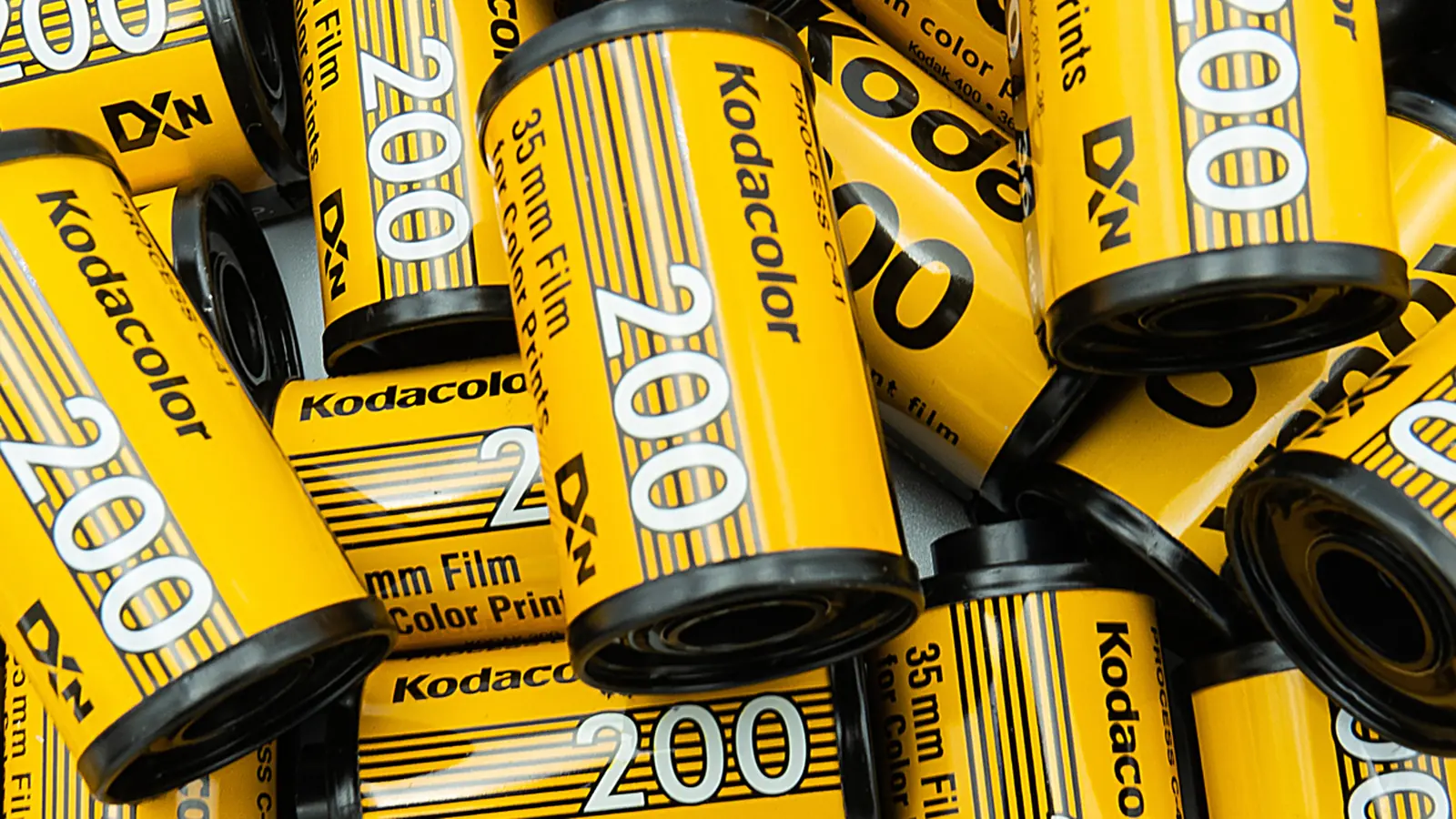

Watch the storyKodak invented the digital camera in 1975 and filed for bankruptcy protection in 2012. The question this backtest asks is not whether the disruption was survivable, but whether it was visible. Replaying the patent record with nothing that was not already public, the improvement rate separated digital imaging from silver-halide film in 1983 — seventeen years before film sales went off a cliff.
Kodak's leadership was not blind. Each of these positions held at board level, and none of them was the variable that decided the outcome.
“Film quality was simply better.” True for decades — early digital was a toy next to a good film print. The rate does not measure who is ahead; it measures who is closing.
“Film margins were extraordinary; digital's were thin.” Rational finance: why trade a razor-blade business for commodity hardware? The rate priced the trend; the P&L priced the present.
“Kodak did respond.” Kiosks, Photo CD, the Advantix film system, an early digital SLR line — adjacent bets that protected film's role rather than following the fastest-improving technology.

“It would have been great if we'd had something like GetFocus to show management how serious the situation was.”
The same missing measurement cuts both ways: the technology you build and shelve, and the one you keep funding long after the evidence has turned.
Steven Sasson's 1975 prototype was toaster-sized, 3.6 kg and 0.01 megapixels. Executives shelved it to protect film margins. In 1981 Sony's Mavica prompted a landmark internal assessment, which concluded that digital would replace film in roughly a decade. The finding changed nothing.
By 1994 Kodak was manufacturing the Apple QuickTake 100, one of the first consumer digital cameras. The capability was in-house; the commitment was not.
In February 1997 Kodak's market value topped out near $31 billion, and film ran 2,611 new patent families that year — more than every digital technology combined. Digital imagers did not out-file film until 2010, by which point the disruption was well underway.
The improvement rate had said the opposite the whole time: film at 23–26%/yr against CCD at 30–90%. Film never moved on either underlying metric — not cycle time, not knowledge flow.
“If technology A consistently improves faster than technology B, then disruption is only a matter of time.”
Digital beat film. But CCD, the technology that beat film, was itself being out-improved — and the rate flagged it in 2000, five years before the filings agreed and fifteen before Sony exited.
The first camera phones shipped the same year. Round two was already decided.
The rate read, 2000 — CMOS 32.3% · CCD 30.6% · FILM 23.1%
The pattern of this entire library, repeating inside the digital camp.
The rate read, 2005 — CMOS 58.1% · CCD 30.2% · FILM 23.0%
The company whose Mavica startled Kodak in 1981 exited the technology that beat film — exactly as the rate had been saying since 2000.
The rate read, 2015 — CMOS 51.8% · CCD 28.9%
CCD's cycle time stretched from under four years to almost seven while its knowledge flow halved. CMOS held a knowledge flow near 1.1 for two decades.
The rate is forecast from two citation metrics — cycle time and knowledge flow. Both were readable the whole time.
“Kodak's management could have known that its film business was about to be disrupted almost two decades before it eventually happened.”

The backtest answers a narrower question than hindsight usually allows. Not whether Kodak should have moved faster, but whether the information required to move was available, and when. Two searches on public patent data — one for silver-halide film, one for digital imagers — separate the winner from the loser in 1983, using only inventions that had already published.
“Among competing technologies, the fastest improving technology always wins. With GetFocus you can see technology disruption coming up to decades in advance.”
Bring us one live technology decision. We'll send back a decision-grade brief in 48 hours: the radar, the improvement rates, the triggers. No theory.
Free · 48 hours · preliminary scoping — validated radars come with a subscription