Stay ahead of the curve
Get exclusive insights delivered directly to your inbox. Join thousands of tech leaders.
TL;DR
- You own the deliverable only if the contract assigns it in writing. Under US law a commissioned study is a work made for hire only in nine listed categories (17 U.S.C. §101).
- Expect the provider to keep its data and method, and check the contract. For EU-based database makers, the database right runs fifteen years (Directive 96/9/EC, Articles 10 and 11).
- US copyright leaves the finding free (17 U.S.C. §102(b)), so it does not stop the same question being answered for a rival. Confidentiality duties, trade secret law and an exclusivity clause can.
- Test a provider on a decision that is already public before you share a live one, and sign the confidentiality agreement before the first briefing.
When you hire a technology intelligence provider, you own the analysis only as far as the contract says so in writing. Under US law a commissioned study is a work made for hire only in nine listed categories, and only with a signed agreement (17 U.S.C. §101). On resale, US copyright protects a report's wording and leaves the finding free (§102(b)), so owning the report does not stop a provider from answering the same question for your competitor. Confidentiality duties, trade secret law and an exclusivity clause can. Expect the provider to keep its data and method, and check that the contract says so.
We build GetFocus, which measures how fast competing technologies improve from the way patents cite each other. This is a buyer's checklist for R&D and strategy leaders, built on public legal texts read in November 2026. It is general information and does not replace legal advice from your counsel.
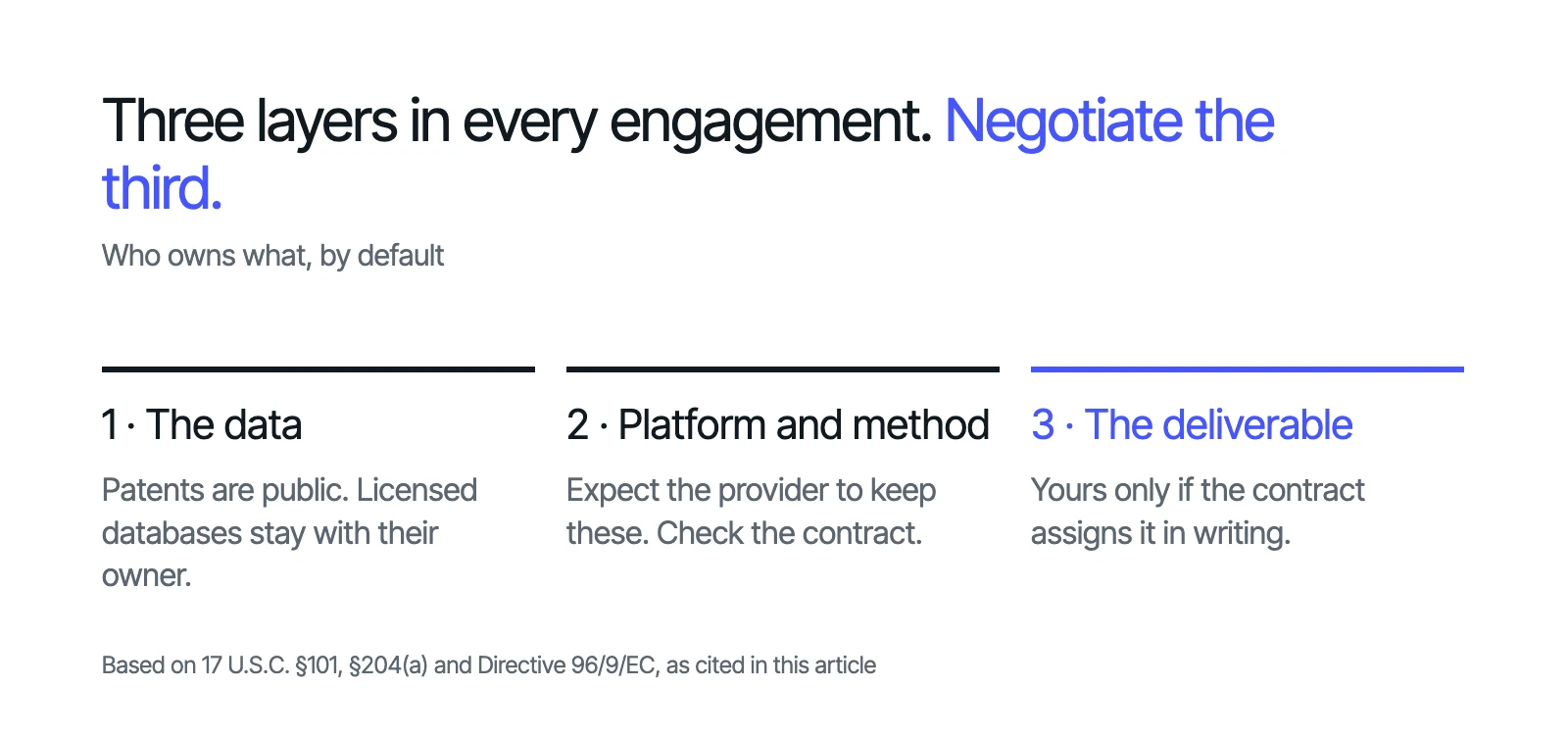
- An engagement has three layers: the underlying data, the provider's platform and method, and the deliverable made for you. The third is the one to negotiate.
- A licence lets you use the deliverable. An assignment makes it yours, and US law requires a signed writing for it (17 U.S.C. §204(a)).
- US copyright covers a report's wording and leaves the finding free, so check the confidentiality and exclusivity clauses.
- Your question is the sensitive part. Sign a confidentiality agreement before the first briefing.
Who owns the analysis when you hire a technology intelligence provider?
The underlying data. Patents are public. The European Patent Office publishes an application as soon as possible after eighteen months from the filing or priority date (European Patent Convention, Article 93). A curated database is different. Directive 96/9/EC lets a maker who invested substantially in obtaining, verifying or presenting the contents prevent extraction or re-utilisation of a substantial part (Article 7), for fifteen years from 1 January after completion, with a fresh term after a substantial new investment (Article 10). The right applies to makers who are nationals of, or companies based in, a Member State (Article 11). Check what access the contract gives you to this layer and what you may export.
The platform and the method. Search tools, models and scoring maths serve every client. Expect the contract to reserve them for the provider.
The deliverable. The report, the dataset built for your question, the charts and the recommendation. Ownership of this layer is open to negotiation.
GetFocus's public radar on EV battery chemistries (updated May 2026) reads sodium-ion's improvement rate at 124.9% a year against 64.8% for LFP. The patents behind that reading are public. The method, an explainable regression on two citation metrics, is the provider layer and is described on the method page. The reading sits on an open page that any competitor can read. A commissioned version would add what never appears there: which chemistry you are weighing, for which product, and what rides on the answer. The contract has to protect that context.
Licence or assignment: which one do you get for the deliverable?
A licence is permission to use the deliverable while the provider stays the owner. An assignment moves ownership to you. Paying for a study does not settle which one you have.
The US Copyright Office's Circular 30 describes two situations in which a work is made for hire: an employee creates it as part of the job, or a certain type of work is commissioned under an express written agreement. The statute lists nine such types, among them a translation, a compilation, a test and an atlas (17 U.S.C. §101).
For a study outside those nine, ownership reaches you through a transfer, and a transfer "is not valid" unless it is in writing and signed by the owner (17 U.S.C. §204(a)). Dutch law, as one European example, requires the agreement that assigns a copyright or grants an exclusive licence to be in writing (Auteurswet, Article 2(3), text in force from 1 January 2026).
The US Copyright Office concluded in January 2025 that outputs of generative AI are protected by copyright only where a human author has determined sufficient expressive elements, and that prompts alone do not qualify (Copyright Office, 29 January 2025). Where a report is largely generated, there may be little copyright to assign, and the contract clauses carry the weight.
Can the provider sell the same insights to your competitors?
Copyright does not stop it. In the US, copyright does not extend to "any idea, procedure, process, system, method of operation, concept, principle, or discovery" (17 U.S.C. §102(b)). You can own every page of the report, and copyright still lets the provider answer the same question for a rival in a new one.
Other duties can restrict it: a confidentiality agreement, trade secret law and an exclusivity clause. Your own patents become public about eighteen months after filing, so competitors can already read where you have been (how R&D teams gather competitive intelligence). The question you bring to a provider shows where you are going next.
The EU Trade Secrets Directive protects information that is secret, has commercial value because it is secret, and "has been subject to reasonable steps" to keep it secret (Directive (EU) 2016/943, Article 2). Using or disclosing it in breach of a confidentiality agreement "or any other duty not to disclose", or of a duty to limit its use, is unlawful (Article 4(3)). Signing a confidentiality agreement before the first briefing is one way to put those steps on record.
Read the reuse clause too. In a field with five serious players, an "anonymised" benchmark line about a European packaging company and a barrier coating points straight at you (an illustrative example).
What should the contract with a technology intelligence provider say?
| Clause | What to ask | Why it matters |
|---|---|---|
| Ownership of the deliverable | Assigned to us or licensed? If licensed: perpetual, group-wide, valid after the contract ends? | Without a signed transfer you hold what the licence says (17 U.S.C. §204(a)). |
| Provider's data, platform and method | What stays yours, and what may we export and keep? | For EU-based makers, the database right covers extraction of a substantial part (Directive 96/9/EC, Articles 7 and 11). |
| Confidentiality of the question | Does it cover the question, the brief and the fact that we are a client, from the first call? | Trade secret protection depends on reasonable steps to keep it secret (Directive (EU) 2016/943, Article 2). |
| Exclusivity on the same question | Will you run this question for named competitors? For how long, in which field, at what price? | US copyright leaves the finding free (17 U.S.C. §102(b)). A clause can restrict a rerun. |
| Reuse in benchmarks and marketing | May our project feed aggregate or anonymised benchmarks or case studies? Can we opt out? | In a narrow field an anonymised example can still identify you. |
| AI training | Do our questions, uploads or outputs train any model, yours or your model providers'? | Your inputs describe your roadmap. |
| Exit | What can we export, what is deleted and when, and do licences to past deliverables continue? | A licence tied to a subscription can end with it. |
Hosting, retention, audit reports and the no-training clause are covered in our eight security questions for AI patent platforms. The same care applies when a colleague pastes the brief into a general assistant (ChatGPT and Copilot for technology scouting).
Can we test a provider without sharing our confidential R&D plans?
Yes, in three ways:
- Replay a decision that is already public. Give the provider a technology shift your industry has lived through and allow only data public at the time. You see the method at work and reveal nothing about your roadmap. GetFocus publishes seven such replays on its proof page.
- Ask a neighbouring question. Same field, one step away from your roadmap.
- Sign first, then share. Put the confidentiality agreement in place and run one live decision.
GetFocus's 48-hour Decision Brief asks for one technology decision you are weighing and returns a custom analysis within 48 hours. For a sensitive decision, the same page offers a walk-through of the approach with an example based on your business context, "no technology decision required". Ask for the confidentiality terms before you send anything sensitive.
We need an independent second opinion on a big technology bet: who can give us one?
Look for someone with no stake in which option wins, and ask three things before you brief anyone. Who else do you work for in our field, and do you advise a vendor of one of the options? Do you earn anything from the option you recommend, such as implementation work? Who owns the opinion, and may you reuse it for those other clients? Put the answers in the contract, next to the exclusivity and reuse clauses.
"Trusting the room" is one of the six R&D strategy blind spots we describe. Ask to open the evidence behind each number. GetFocus's method page states that every number traces back to the patent record, and its AI patent analytics page calls the forecast a directional signal.
Where does this checklist stop?
It applies when you buy analysis of public data: a study, a subscription or a platform. It leaves out joint development and contract research, where new inventions need their own agreement. The sources are US and EU texts and one Dutch example, read on 20 November 2026. Your contract and its governing law decide the outcome.
FAQ
Who owns a report written by a technology intelligence provider?
The contract decides. Under US law a commissioned report is a work made for hire only in nine listed categories with a signed agreement (17 U.S.C. §101), and any other transfer of ownership must be in writing and signed (§204(a)). Without an assignment, your rights are those the licence grants.
Can a technology intelligence provider work for our competitor on the same question?
US copyright does not stop it: copyright does not extend to ideas or discoveries (17 U.S.C. §102(b)), so owning the report does not prevent the provider from answering the same question for a rival. A confidentiality agreement, trade secret law or an exclusivity clause can restrict it. Ask for exclusivity with named competitors, a field and a period.
Can we test a provider without sharing our confidential R&D plans?
Yes. Ask the provider to replay a technology shift your industry has already lived through, using only data public at the time. Or ask a neighbouring question in the same field. For a live decision, sign the confidentiality agreement before the first briefing.
Test the method before you share the plan
Bring one technology decision, or ask for the walk-through first. Get a free 48-hour decision brief.