Stay ahead of the curve
Get exclusive insights delivered directly to your inbox. Join thousands of tech leaders.
TL;DR
- To present an R&D bet to a non-technical board, answer three questions: what is changing, what it means for us, what we propose.
- Show one comparison over time, not a snapshot. Improvement rates compared side by side are the comparison boards understand fastest.
- Make the headline the decision, and publish the trigger that would change it.
The audience problem
Most heads of R&D report to someone from finance or marketing. Christophe Perthuisot, former SVP of R&D at Moët Hennessy and Danone, called long-term technology choice "a very high-stakes, solitary game. You have nobody else in your organisation who understands it that well." (Read his story.)
Boards approve decisions they can repeat to their own stakeholders. They do not approve technology they have been taught.
What do executives actually read?
Very little. Senior people rarely open the pre-read, and a long deck gets closed before slide five. Design for that: three simple questions, no technical detail unless someone asks.
The three questions every R&D board presentation must answer
| Question | What to show | What to leave out |
|---|---|---|
| 1. What is changing? | One comparison over time: our technology versus the alternative | How the technology works |
| 2. What does it mean for us? | Opportunity or threat, in money or market terms | Every option you looked at |
| 3. What do we propose? | Fund, pause, partner or watch, with a trigger to revisit | Hedging language |
The one slide
The one slide · board decision
What changed
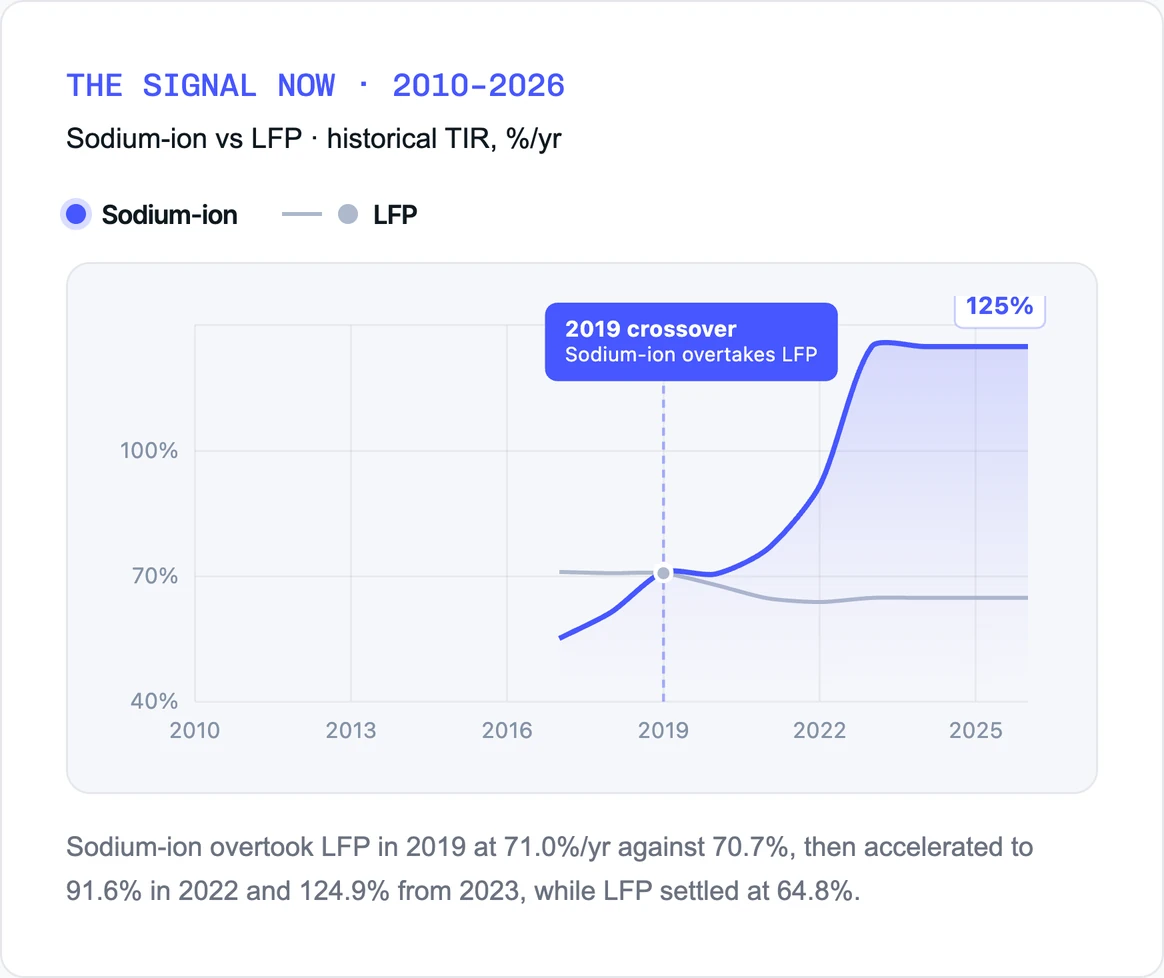
Sodium-ion overtook LFP in 2019 and now improves almost twice as fast: 125% a year against 65%.
What it means
The same pattern LFP showed against NMC, ten years before LFP took the market.
What we propose
Pilots and supplier mapping now. Revisit at each quarterly radar update.
Chart: GetFocus Automotive Technology Strategy Radar, May 2026
The slide above is built from the GetFocus Automotive Technology Strategy Radar. It follows four rules.
- The headline is the decision. "Fund sodium-ion pilots now" is something a board can approve. "Sodium-ion battery landscape" is not.
- One comparison over time. Sodium-ion overtook LFP on Technology Improvement Rate in 2019 and now improves almost twice as fast: 125% a year against 65%. A board member does not need to know what a cathode is to read two lines diverging.
- One precedent. LFP showed the same pattern against NMC a decade before it took the market. Boards trust a pattern that already played out.
- A trigger. The recommendation says when it will be revisited and what would change it. That makes a later change of course a plan, not a reversal.
Why the rate works on a board
Boards already think in compounding: interest, growth, market share. An improvement rate is the same idea applied to a technology. "Their route improves 50% a year, ours 5%" lands faster than any feasibility study, and the method behind it is explainable maths on public patent data, peer-reviewed at MIT, not a model's opinion.
It also answers the question every executive asks silently: what if we're wrong? Show the alternatives you considered and their rates. And if the board doubts the method, show it a case it remembers. The backtest library replays seven disruptions using only patents public at each date, from Kodak to LED lighting.
Put a number on it
Budgets are won in money, not in technical milestones: if we solve this, we gain X. Pair the rate with the money. The storage backtest is the template: Western Digital could have entered flash for $65M in 2009 and paid $19B in 2015.
Checklist: one slide for a board-level R&D decision
- Headline states the decision, not the topic.
- One chart comparing two or three technologies' improvement rates over time.
- One line on what it means in money, market share or risk.
- The recommendation, its cost, and the trigger to revisit it.
- One line on what waiting would cost.
FAQ
How do you justify R&D investment to a board?
Link the investment to an outcome the board already cares about, show that the chosen technology is improving faster than the alternatives, quantify the upside or the cost of waiting, and propose a staged commitment with a clear review trigger.
What should an R&D strategy presentation include?
The decision you are asking for, one comparison over time as evidence, the business impact, the alternatives you rejected, and the trigger that would change your recommendation.
How long should a board presentation on R&D be?
One slide for the decision, with detail held back for questions.