Stay ahead of the curve
Get exclusive insights delivered directly to your inbox. Join thousands of tech leaders.
TL;DR
- LED vs incandescent: about 83 against 16 lumens per watt, and more than 30 times the rated life (U.S. Energy Information Administration, 2014).
- In February 2007 GE announced a high-efficiency incandescent lamp aiming for 30 lumens per watt by 2010. It suspended the programme in December 2008.
- Our backtest reads LED improving 32.5% a year against 8.6% for incandescent in 1990, using only patents public at the time.
- For R&D leaders: compare the improvement rates of competing technologies before funding an upgrade to the core.
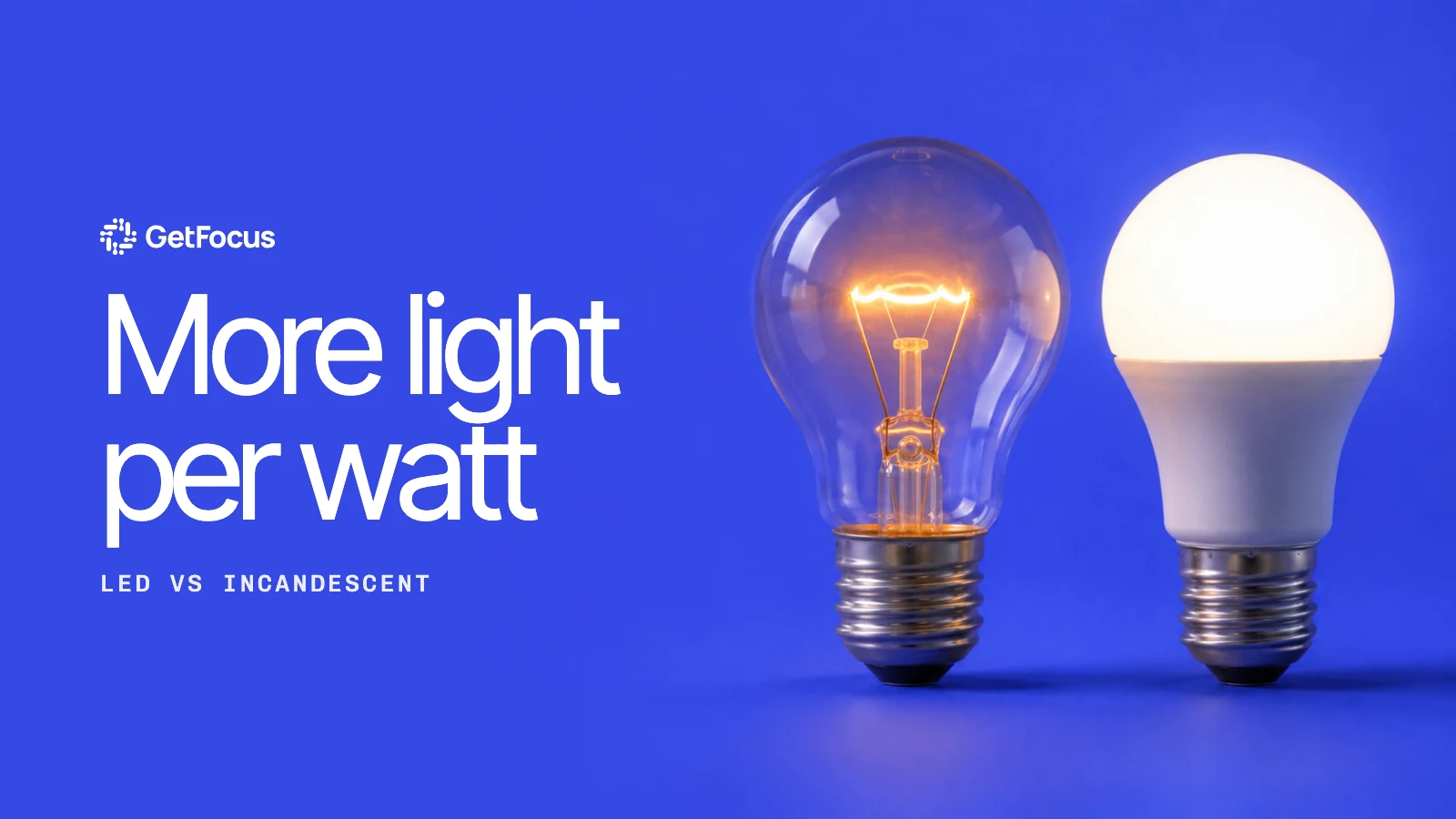
In the LED vs incandescent comparison, the LED wins on efficiency, lifespan and running cost: on the U.S. Energy Information Administration's 2014 figures it gives about five times more light per watt, is rated to last more than thirty times as long, and uses about 80% less electricity for the same light. A typical 60-watt incandescent bulb produces about 16 lumens per watt, a comparable LED was already at 83 in 2014 (U.S. Energy Information Administration), and the legal minimum for household bulbs in the United States is now 45.
The harder question, and the one that matters if you run R&D, is why the company Thomas Edison founded announced a programme in 2007 to build a better filament. This article answers the buyer's question first, then replays GE's decision against our lighting backtest, which shows what the patent record said about both technologies from 1990 onwards.
LED vs incandescent: which is more efficient, lasts longer and costs less?
The LED comes out ahead on all three, and the table shows each figure with its source.
| Measure | Incandescent | LED | Source |
|---|---|---|---|
| Light per watt | About 16 lumens per watt (typical 60 W bulb) | About 83 lumens per watt in 2014; record just over 300 | EIA, March 2014; Royal Swedish Academy of Sciences, October 2014 |
| Rated life | About 1,000 hours | More than 30 times as long as a comparable incandescent | EIA, March 2014 |
| Where the energy goes | 90% released as heat | Produces light up to 90% more efficiently | ENERGY STAR |
| Electricity for one bulb, 3 hours a day (worked example) | 65.7 kWh a year, about $11.93 | About 13.1 kWh a year, about $2.39 | Our arithmetic from EIA figures; see below |
| US minimum of 45 lumens per watt | Below it | Above it | DOE rule, April 2022 |
Efficiency
An incandescent bulb makes light by heating a tungsten filament until it glows, and ENERGY STAR puts the share of its energy released as heat at 90%. An LED is a semiconductor that emits light directly. The EIA measured typical 60-watt incandescent lamps at 16 lumens per watt and LED lamps at around 83 in 2014, and the Royal Swedish Academy of Sciences reported a record of just over 300 lumens per watt the same year (Nobel Prize press release).
Lifespan
The EIA puts the useful life of an incandescent lamp at 1,000 hours on average and rates LED lamps at more than 30 times that. At three hours of use a day, 1,000 hours is about eleven months, and 30,000 hours is about 27 years. The Academy's figure for the LED itself is up to 100,000 hours, against 1,000 for incandescent bulbs and 10,000 for fluorescent lamps.
Cost
Here is a worked example with stated assumptions. A 60-watt incandescent at 16 lumens per watt gives about 960 lumens, and an LED at the 2014 figure of 83 lumens per watt gives the same light from about 12 watts. Used three hours a day, the incandescent draws 65.7 kWh a year and the LED about 13.1 kWh. At the average US residential price of 18.16 cents per kWh in August 2026 (EIA Electric Power Monthly), that is about $11.93 a year against $2.39, per bulb.
Efficient bulbs cost more to buy and earn it back over their life, the EIA notes. When the Department of Energy finalised the 45 lumens-per-watt minimum in April 2022, it estimated the rules would save a family about $100 a year (Utility Dive).
Why did GE build a better filament in 2007?
On 23 February 2007, GE announced what it called an advancement in incandescent technology: high-efficiency incandescent (HEI) lamps, targeted for market by 2010. The first lamps were to be nearly twice as efficient as existing bulbs, at 30 lumens per watt, with a long-term goal of about four times the efficiency, comparable to compact fluorescents (GE press release).
The case was defensible. Household incandescent bulbs were, in GE's words, the most popular lamp type in use, people liked their light, and regulators were about to demand efficiency. In December 2007 the US Energy Independence and Security Act set standards that traditional bulbs could not meet, and the EU followed in 2009.
Less than two years after the announcement, in December 2008, GE said it had suspended HEI development to put more focus and investment into LEDs and OLEDs, in a statement carried by the lighting trade site LightNOW. In May 2020 GE agreed to sell its lighting business, then nearly 130 years old, to the smart-home company Savant Systems (GE press release).
The first HEI target was 30 lumens per watt. The minimum the United States now requires is 45, and LED lamps were at 83 by 2014.
What did the patent record say about LED vs incandescent in 1990?
We build GetFocus, which measures how fast a technology improves. The measure is the improvement rate: the percentage by which a technology's performance improves each year, estimated from how patents cite each other. Two citation metrics carry it. Cycle time is the number of years between one generation of inventions and the next. Knowledge flow is how much later work builds on each invention. A rate compounds like an interest rate, which is why technology improvement is predictable.
Because every patent carries a date, the record can be replayed using only the patents that were public in a given year. That is what the lighting backtest does, and this is its timeline (GetFocus platform exports, August 2026):
- 1990. LED reads 32.5% a year and incandescent 8.6%. White LED lighting did not exist yet; LEDs were indicator lights.
- 1993. Shuji Nakamura demonstrates the efficient blue LED at Nichia. LED 30.5%, incandescent 8.4%.
- 2002. The industry's filing activity catches up: new LED patent filings pass incandescent filings for the first time, twelve years after the rate gap was visible. Filing volume plays no part in the improvement rate.
- 2007. The year of GE's announcement. LED 47%, incandescent 8.8%.
- 2026. LED 37.7%, incandescent 11.2%.
To make the 1990 gap concrete: by our arithmetic, something that improves 32.5% a year doubles in about two and a half years, and something that improves 8.6% a year doubles in a little over eight.
The two metrics underneath tell the same story. LED's cycle time ran five to six years against twelve to fifteen for the incandescent bulb, and its knowledge flow was about three times as high.
So when GE announced HEI, the gap had been in the public record for seventeen years. The programme set out to double filament efficiency once, by 2010. If LED's 2007 rate held, its performance would compound to about 3.2 times over the same three years (our arithmetic: 1.47 × 1.47 × 1.47).
Why did smart people defend the filament?
Each argument for the filament was true on the day it was made. In 1990 LEDs gave no white light and could not light a room. Early LED lamps cost dozens of times more than a bulb. Consumers liked the warmth and dimming of incandescent light, which made bulb rules politically contested. And GE's engineers did have a credible route to a more efficient filament.
All four arguments describe the product catalogue of the day. The improvement rate describes the direction and speed of the technology behind the catalogue, and that reading favoured LED by a factor of about four in 1990, and by more in 2007. When the Royal Swedish Academy of Sciences honoured the blue LED in 2014, it wrote that "the 21st century will be lit by LED lamps".
What should an R&D leader take from LED vs incandescent?
Three checks follow from the GE story.
- Compare rates inside one job. Put the competing technologies for the same function side by side and read how fast each improves, next to how mature each is today. Maturity favoured the filament for a century; the rate had favoured LED since 1990.
- Test the incumbent programme against the rival's compounding. Before funding an improvement to the core, ask what the rival reaches over the same years at its current rate. A doubling by 2010 looked ambitious on its own and small next to 47% a year.
- Set the stop trigger before you start. GE stopped HEI in under two years. A trigger written in advance, tied to the rival's rate and price, makes that call earlier and cheaper. Our article on when to move away from a core technology covers how to set one.
GetFocus is technology forecasting software built around this reading, and our backtest method explains how we check it against history.
What are the limits of this reading?
The improvement rate is directional. It told a reader in 1990 which technology was improving faster and by roughly how much. It gave no date for the first white LED lamp, the price crossover or the bulb regulations, and those were set by physics breakthroughs, manufacturing scale and politics.
The backtest also says nothing about what GE could have earned by moving earlier; it replays the technology signal only. The consumer figures above come from US sources, the LED efficiency figure dates from 2014 and bulbs on sale today vary, and the cost example rests on our three-hours-a-day assumption.
Frequently asked questions
Is LED more efficient than incandescent?
Yes. A typical 60-watt incandescent bulb produces about 16 lumens per watt and LED lamps were at around 83 in 2014, according to the U.S. Energy Information Administration. That is about five times more light for the same electricity.
How long do LED bulbs last compared with incandescent bulbs?
Incandescent lamps last about 1,000 hours on average. LED lamps are rated to last more than 30 times as long, according to the U.S. Energy Information Administration.
Are incandescent bulbs banned?
In the United States, household bulbs must now produce at least 45 lumens per watt under a Department of Energy rule finalised in April 2022. Traditional incandescent bulbs produce about 16, so they fall below the minimum. The EU began phasing them out in 2009.
What was GE's high-efficiency incandescent lamp?
A programme GE announced in February 2007 to make incandescent bulbs nearly twice as efficient, at 30 lumens per watt, by 2010. GE suspended it in December 2008 to focus on LEDs and OLEDs.
Is there a filament in your own portfolio?
If one of your core technologies has a faster-improving rival, the rate can tell you how wide the gap is today. Send us one live technology decision and within 48 hours you get a free preliminary Decision Brief: a first-pass radar of the competing options, their improvement rates and suggested triggers. Get a free 48-hour Decision Brief.