

How R&D teams can use patent trends to forecast emerging technologies
You don’t get second chances in R&D. In a world where every quarter brings a new surprise AI, green tech, quantum computing betting on the wrong technology or being even six months late can set your roadmap back years.So how can R&D teams stay ahead?
By shifting focus from market noise to patent‑derived signals the earliest indicators of true technological progress.
In collaboration with PatentRenewal.com, a company specializing in automated, transparent and cost-effective IP renewals, we explored the rule of patent trends in the 2025 R&D market .
The limits of current signals
Most organizations lean on market reports, analyst briefings, or VC trends. They shine a light on what’s already winning but by then, the winners have often been decided.
Patent data, in contrast, captures intent and invention before commercialization. Yet, with millions of filings every year the noise is overwhelming.
Even patent offices are feeling the strain: the USPTO's backlog of unexamined applications hit a record 830,020 in early 2025.
This emphasizes why right now, R&D teams must be more strategic, not just more informed.
Why patent trends are R&D’s crucial compass
Patents are strategic breadcrumbs, globally timestamped and revealing where innovation is brewing.
- Velocity signals momentum: Filing surges indicate fields heating up quickly.
- Citation patterns reflect influence: Which inventions are shaping future work?
- Speed of recognition matters: First-citation lag can highlight early winners before mainstream attention.
The patent-derived metrics every R&D team needs
For example, “Patent Power” rankings show that Amazon topped 2024 not by volume but by impactful, widely cited patents; whereas Samsung led in sheer numbers. Explaining why quality matters as much as quantity.
From trend-watching to prediction: technology improvement rate
Patent trends show activity but not progress. That’s where Technology Improvement Rate (TIR) steps in.
TIR combines:
- Cycle time (how recently cited prior patents are)
- Knowledge flow (how rapidly newer patents are cited)
It measures not just how much work is being done, but how fast the technology itself is improving.
For R&D leaders, this matters because filing volume alone doesn’t predict winners. TIR provides a directional signal that helps teams decide which technologies will mature fast enough to justify significant investment.
In fields like SSD vs. HDD, such metrics revealed the performance curve tilting years before SSD adoption soared. Similarly, TIR analysis highlighted LFP batteries as a fast-improving chemistry long before their mainstream use in EVs.
Recent research introduces advanced multi-task learning models that forecast patent citation trends across multiple timeframes simultaneously, demonstrating improved prediction accuracy compared to standard approaches. The research builds on the same principle: patents are predictive signals.
How R&D teams can use TIR:
- Benchmark competing technologies by improvement rate.
- Detect inflection points before market adoption.
- Validate or challenge roadmap bets with objective progress signals.
- Spot which competitor portfolios are backed by fast-improving IP.
Spotting emerging technologies
R&D leaders need to know where the next breakthroughs are likely to surface. Patent data provides three powerful signals to help spot these inflection points early:
1. Growth in filings = early momentum
A sharp rise in filings within a technology field often marks the early stages of market growth. For example, filings around generative AI and quantum computing have surged in recent years, long before their full commercial maturity. When tracked consistently, these growth curves act as early warning indicators that a field is heating up.
2. Cross-industry patenting = convergence in motion
When companies file outside their traditional domains like automotive giants patenting in AI, autonomous driving, or battery chemistry it signals industries colliding to form entirely new ecosystems. These cross-domain moves are often the earliest clues of convergence, where breakthroughs tend to accelerate fastest.
3. White space = opportunity waiting
Patent landscapes also reveal the gaps. Areas with little or no patenting activity so-called white space are where unmet needs exist but no one has staked IP territory yet. Identifying these spaces lets R&D teams innovate ahead of the crowd, positioning themselves in markets before competition catches up.
Real-world patent signals from 2024–2025
- Generative AI patents surged, with WIPO reporting over 50,000 GenAI applications in the past decade, 25 % of which were filed in 2023 alone. China accounts for the lion’s share six times more than the U.S.
→ This surge highlights how innovation leadership is shifting eastward and consolidating around AI’s core battlegrounds. - Global patent filings continue to climb, growing 4 % year-over-year with AI-linked filings up significantly across subclasses.
→ Momentum is no longer limited to niche fields, AI is becoming a backbone of innovation portfolios worldwide. - The Patent Analytics market is booming, expected to hit $1.89 billion by 2029, led by AI‑driven analysis and increasing R&D spend.
→ Reflecting how organizations are institutionalizing patent intelligence as a strategic necessity. - Green tech innovation is accelerating: over 750,000 patent families now focus on clean technologies (~12 % of global IP), especially from Asia.
→ Showing where governments and corporations are doubling down, sustainability is a global IP race. - In quantum computing, filings are exploding: China’s share jumped from 1,011 (2014) to 7,308 (2024), while firms like IonQ now boast 1,000+ IP assets.
→ The speed at which patents are being granted is a sign that we may see real quantum breakthroughs sooner than expected.
Practical use cases for R&D teams
- Identifying research gaps: Direct resources to underexplored but fast-moving areas.
- Benchmarking competitors and new entrants: Track how your portfolio stacks up against theirs.
- Finding collaboration or licensing opportunities: Spot external innovators working on complementary IP.
- Avoiding duplication and freedom-to-operate risks: Reduce wasted R&D spend and legal exposure by ensuring you’re not reinventing what’s already protected
- Align innovation priorities: With IP lifecycle decisions such as patent renewals, ensure your resources are invested only in technologies with real momentum.
What R&D teams should do now
- Map velocity across strategic domains: Identify fields with 2 consecutive quarters of ≥ 20 % growth in filings.
- Track early citation activity: Flag patents with fast first-citation lag (within 12–24 months).
- Compare TIR across competing technologies: Accelerating curves often lead to disruption.
- Blend with market signals: Don’t ignore scouting, M&A, or customer trends but weigh them with patent-based insight.
- Reorient or reinforce portfolio: Double down on accelerating domains, pivot from stale ones.
Markets talk but they’re often late to the story. Patents whisper early and clearly if you know how to listen.
By integrating velocity, citation dynamics, and improvement rates, R&D leaders in tech-heavy organizations can shift from reactive trend watching to proactive foresight, spotting tomorrow’s breakthroughs while others are still chasing yesterday’s headlines.
Integrating patent insights into R&D strategy
Patent intelligence delivers the most value when it’s embedded into ongoing strategy, not treated as a one-off exercise:
- Combine with market research: Layer patent signals with customer demand, funding trends, and competitor activity for a full 360° view.
- Build dashboards and review cycles: Establish quarterly or even monthly processes where R&D, strategy, and IP teams review velocity, citations, and TIR alongside market inputs.
- Make it actionable: Feed insights directly into roadmaps, guide investment priorities, and focus talent where innovation is accelerating fastest.
When patent insights become part of your operating rhythm, they move from being just data points to becoming a strategic compass ensuring your team is not only informed but positioned to lead.



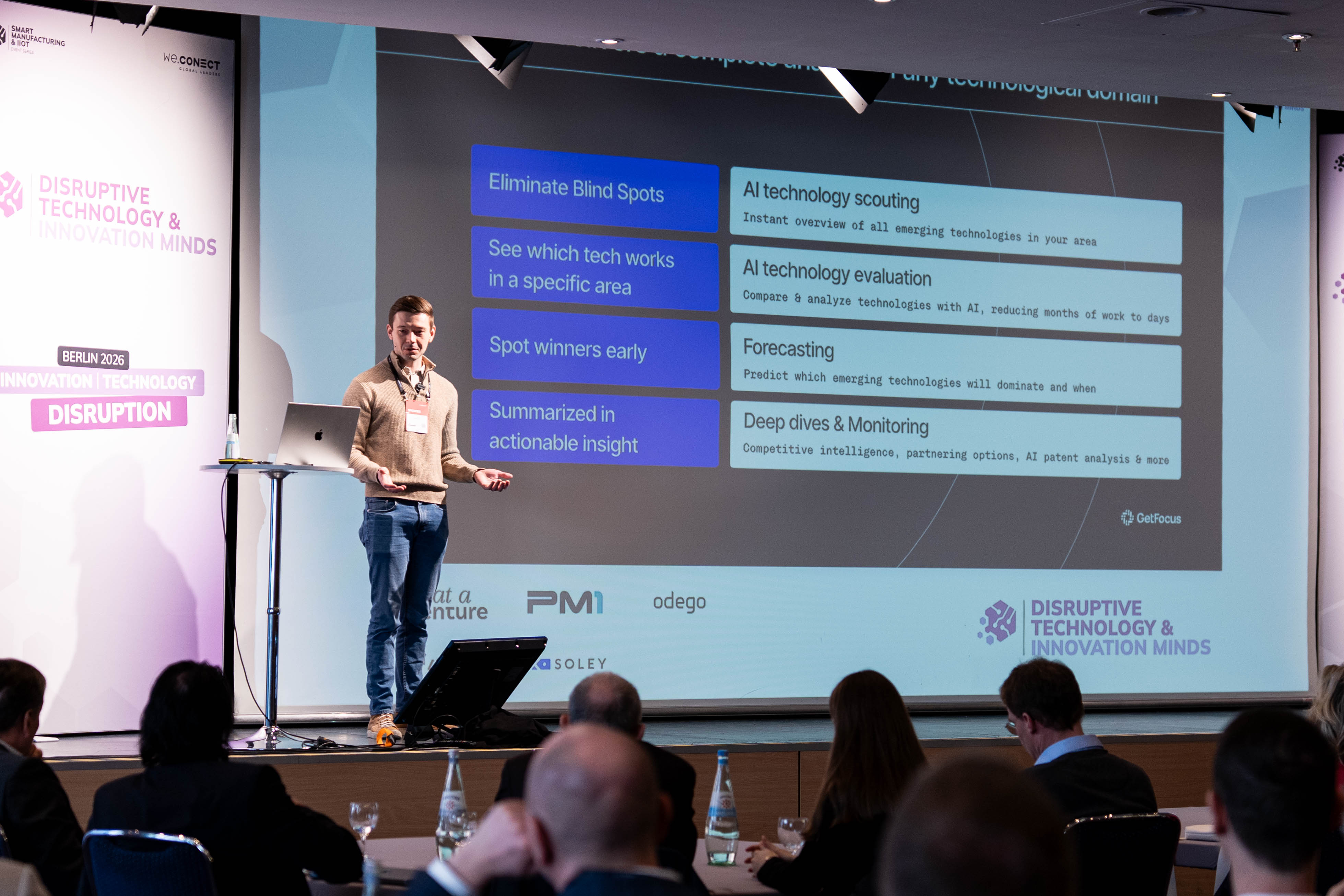
Ready to see it in action?
Discover how GetFocus can transform your strategic decision-making process today.