← All webinars
On demand
Jun 25, 2026

Is sodium-ion the next LFP?

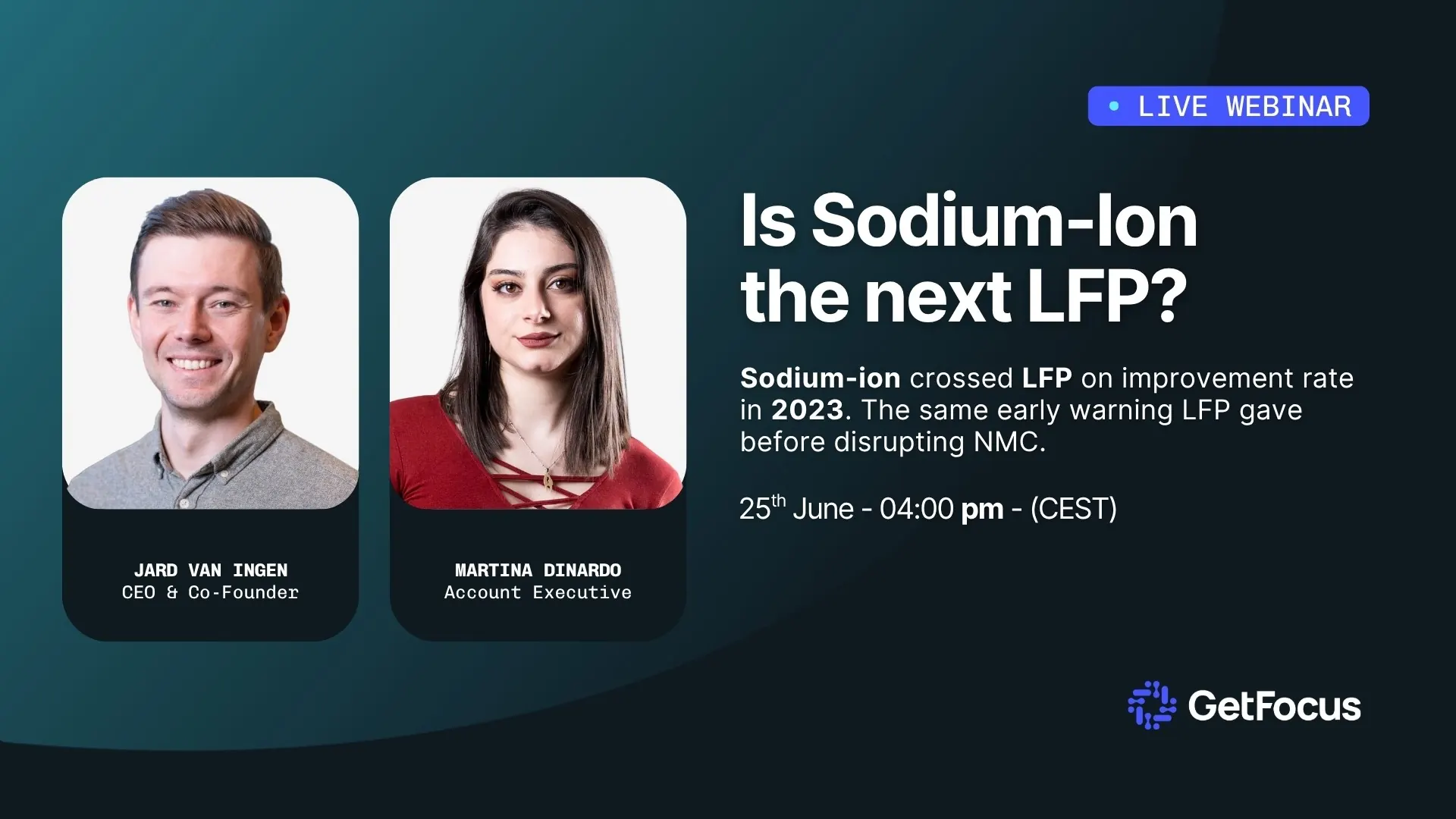
Sodium-ion crossed LFP on improvement rate in 2023. LFP gave the same early warning before it disrupted NMC. Here’s what the patent data says about the EV battery race to 2030.
Is sodium-ion the next LFP?
Loading video
0:00
/
40:00
video
2400
Resources:
Read the full report
Share
Speakers
Date
Jun 25, 2026
Time
16:00 CEST · 10:00 ET
Format
40 min
Save your seat
Can’t make it live? Register anyway and we’ll send you the recording.
By registering you agree to our Privacy Policy. We’ll email you the join link and the recording.
Thank you! Your submission has been received!
Oops! Something went wrong while submitting the form.
You’re registered
The join link is on its way to your inbox. Add the session to your calendar so you don’t miss it.
Add to calendar
On demand
Jun 25, 2026
16:00 CEST · 10:00 ET
40 min
Jard van Ingen & Martina Dinardo


Will sodium-ion disrupt LFP in EVs before 2030, the same way LFP disrupted NMC? Our CEO Jard van Ingen and Account Executive Martina Dinardo put the question to the patent data, measuring how fast every major EV chemistry is improving: sodium-ion, LFP, LMFP, M3P, NMC, NCA, high-nickel lithium-ion and solid-state.

You’ll leave with
  • Current improvement rates for the three chemistry families: roughly 113% a year for sodium-ion, 58% for LFP, LMFP and M3P, and 44% for NMC, NCA and NCMA
  • A decision matrix placing every cathode, anode, electrolyte and manufacturing route by improvement rate and readiness
  • A conservative 2030 forecast for the EV battery stack, and the hard-carbon anode supply question that could slow it

About this session

Jard opens with the pattern behind the disruptions GetFocus has backtested: film against digital, Nokia against the smartphone, fuel cells against batteries. Each time, the winner was the technology improving fastest, often while it still performed worse. He then walks through the method: 30 years of MIT research showing every technology improves exponentially at its own rate, and the leading indicator in patent citation data, cycle time and knowledge flow, that makes that rate measurable early.

The core of the session applies it to batteries, across 254 datasets covering full cells, cathodes, anodes, electrolytes and manufacturing. Sodium-ion has improved faster than both LFP and NMC since 2023. Jard sets that curve next to the one LFP showed before it took share from NMC, plots each chemistry on the decision matrix, and closes with a 2030 forecast and next steps: pilots, supplier routes and the hard-carbon bottleneck.

The session closes with a live Q&A. Attendees asked whether trade secrets break the method, what happens when a fast improver still loses the market, how much regulation and politics bend the curve, whether patents lag too far behind to be useful, and whether Europe can build the value chain instead of China.

Who it’s for

Battery and cell R&D leaders Automotive strategy teams Technology scouts Materials and sourcing teams

Speakers

Jard van Ingen
Jard van Ingen
CEO & Co-Founder
, 
GetFocus
Co-founder and CEO of GetFocus, which forecasts which technologies will win from patent data, using a method developed with MIT.
in
Martina Dinardo
Martina Dinardo
Account Executive
, 
GetFocus
Account Executive at GetFocus, working with R&D and strategy teams on their technology decisions.
in
“

You won’t get our opinion. You’ll get facts.

Jard van Ingen
CEO & Co-Founder, GetFocus

Ready to see it in action?

Discover how GetFocus can transform your strategic decision-making process today.

Talk to us